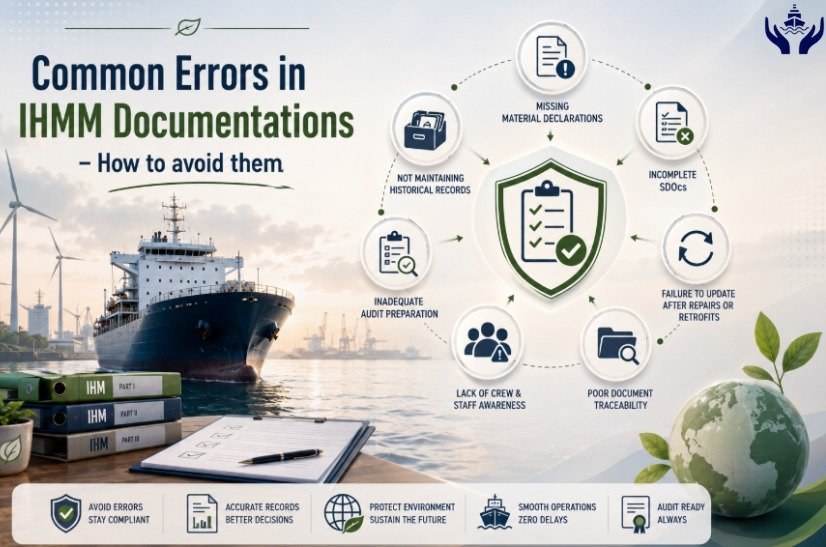
Common Errors in IHM Part I Maintenance — and How to Avoid Them

With the Hong Kong International Convention in force since 26 June 2025, the EU Ship Recycling Regulation (1257/2013) in full effect and IMO’s MEPC.379(80) guidelines evolving, maintaining an accurate Inventory of Hazardous Materials (IHM Part I) is no longer a one-off survey — it is a continuous compliance duty.

Yet many fleets still face compliance gaps from documentation errors, incomplete records, supplier delays and dry-dock omissions. Here are the 10 most common IHM Part I errors — and exactly how to avoid them.

Why IHM Part I Maintenance Is a Continuous Duty

At Varuna Sentinels BV, continuous IHM Part I maintenance is supported through structured PO tracking, MD and SDoC management, supplier coordination, PFOS monitoring, CP lifecycle tracking and audit-ready digital reporting — fully aligned with MEPC.379(80), HKC and EU SRR requirements.

What’s Driving the Pressure

  • Hong Kong Convention in force since 26 June 2025
  • EU Ship Recycling Regulation (1257/2013) in full effect
  • IMO MEPC.379(80) guidelines for IHM upkeep
  • A continuous obligation across the vessel’s operational life

What Errors Cost You

  • Delays during audits and inspections
  • Difficulty at certification renewal
  • Increased operational and financial risk
  • Potential non-compliance with international regulations

The shift: IHM Part I is a living record — not a certificate you file once and forget. Every component installed, replaced or modified must stay documented and traceable.

Understanding IHM Part I Maintenance

IHM Part I Maintenance is the continuous process of updating the hazardous-materials inventory carried on board a vessel during its operational life. Every component installed, replaced or modified must be documented and traceable back to a verified supplier declaration.

A complete IHM Part I workflow must cover:

  • Purchase Order (PO) tracking and validation
  • Material Declarations (MDs) in MEPC.379(80) format
  • Supplier Declarations of Conformity (SDoCs)
  • Equipment, component and retrofit records — including dry-dock additions
  • PFOS and controlled-substance verification (Table A / EU POP)
  • CP (Change / Procurement) updates reflecting every modification
  • Audit-ready documentation and quarterly reporting per vessel

Per MEPC.379(80), HKC and EU SRR: Part I of the IHM must remain properly maintained and updated during the vessel’s entire operational life.

The 10 Most Common IHM Part I Errors — and How to Avoid Them

Each error below pairs what typically goes wrong with the practical steps that prevent it — the exact controls Varuna Sentinels BV builds into a structured IHM Part I programme.

1. Missing or Incomplete Material Declarations (MDs)

What Goes Wrong

  • Hazardous substances cannot be verified — without complete MDs in MEPC.379(80) format, suppliers cannot prove which regulated substances their products contain
  • Compliance traceability is lost — missing declarations break the chain required under HKC and EU SRR audits
  • Audit non-conformities surface late — gaps appear at EU SRR validation that should have been caught at procurement
  • Surveys are delayed — renewals and port-state inspections slow down on missing records

How to Avoid It

  • Raise MD requests with every PO — never after delivery
  • Mandate the MEPC.379(80) Appendix format across all vendors
  • Validate MDs before equipment acceptance — check completeness before signing for goods
  • Centralise digital MD storage per vessel for instant audit retrieval

2. Incomplete Supplier Declarations of Conformity (SDoCs)

What Goes Wrong

  • Unsigned or mismatched SDoCs — wrong format, or references that don’t match the supplied items
  • EU SRR audit non-conformities — SDoCs are mandatory and shortcomings are flagged quickly
  • HKC verification weakened — the Convention expects fully validated supplier declarations
  • Procurement cycles slow down — documentation has to be re-requested, delaying every later order

How to Avoid It

  • Issue one standardised SDoC template to every vendor
  • Validate signatures, dates and references on receipt before accepting items
  • Cross-check each declaration against HKC and EU SRR before filing
  • Maintain vessel-wise supplier records with version history

3. Weak Procurement-to-Compliance Linkage

What Goes Wrong

  • POs and compliance evidence held separately — with no link between them
  • Traceability breaks at the seam — MEPC lifecycle expectations require an unbroken procurement-to-compliance chain
  • Audit questions become unanswerable — which declaration covers which item on which vessel?
  • Quarterly reporting becomes guesswork — consolidation depends on memory, not data

How to Avoid It

  • Link every MD and SDoC to its originating PO on receipt
  • Track POs per vessel and per quarter — structured around the reporting unit
  • Don’t close a PO until compliance evidence is in place
  • Standardise quarterly reporting against PO / MD / SDoC linkage

4. Failure to Update IHM After Dry Dock or Modifications

What Goes Wrong

  • New materials enter the vessel unrecorded — dry-dock work installs materials that never reach the IHM
  • MEPC.379(80) thresholds breached unnoticed — silent additions push the IHM into non-compliance
  • Certification at risk under EU SRR — outdated Part I creates findings at renewal surveys
  • Port-state inspections find stale records — a Part I that doesn’t match the vessel

How to Avoid It

  • Make IHM update a mandatory dry-dock close-out item
  • Keep the CP log live during the yard period
  • Record equipment replacements and retrofits in real time
  • Run post-dock compliance validation before the vessel sails

5. Inadequate Supplier Follow-up

What Goes Wrong

  • Pending MD and SDoC items drift — requests sit unresolved for weeks or months
  • Reminders are inconsistent or skipped — everyone follows up their own way
  • Escalation happens too late — the procurement cycle has already moved on
  • Compliance posture weakens silently — the backlog grows quarter on quarter

How to Avoid It

  • Run a structured three-step follow-up cycle — Reminder 1, 2, 3, then escalation
  • Log every supplier response with date and channel
  • Escalate non-responsive suppliers to vessel management
  • Record every pending item in the Remarks field — no silent gaps

6. Unstructured Change-Management (CP) Updates

What Goes Wrong

  • Modifications happen continuously, updates happen in bursts — the log catches up only when someone has time
  • MEPC lifecycle updates drift out of sync — inventory falls behind the actual configuration
  • EU SRR documentation chain develops gaps — each unrecorded change is a future finding
  • The team loses trust in its own records — and stops using them

How to Avoid It

  • Maintain a real-time CP update log per vessel — the day the change happens
  • Record every vessel modification immediately — onboard or at the yard
  • Integrate CP entries into quarterly reporting as a structural input
  • Validate every change before it enters the official inventory

7. Incomplete Quarterly Compliance Reporting

What Goes Wrong

  • Data scattered across spreadsheets and inboxes — quarter-end becomes a hunt-and-gather exercise
  • Performance trends invisible — no way to see whether things improve or decline
  • Audit preparation rushed — reports compiled days before, not months in advance
  • KPI tracking has no baseline — MEPC / HKC / EU SRR alignment cannot be measured

How to Avoid It

  • Run a strict Q1–Q4 cycle with internal cut-off dates
  • Validate MD, SDoC, PO, PFOS and CP completeness before submission
  • Issue an audit-ready digital report per vessel every quarter
  • Hold the deadline — late quarters compound

8. PFOS and Controlled-Substance Gaps

What Goes Wrong

  • PFOS is controlled under multiple frameworks — IHM hazardous-materials tables, the Stockholm Convention and the EU POP Regulation (2019/1021)
  • Verification gets skipped at procurement — the chemistry feels distant from purchasing
  • Environmental compliance exposure — missing entries leave the vessel exposed
  • Inspector scrutiny concentrates here — on the part of the inventory most often left incomplete

How to Avoid It

  • Verify PFOS compliance for every applicable material at PO stage
  • Collect a Manufacturer Declaration for each PFOS-relevant item
  • Maintain a vessel-level PFOS tracking record alongside the main IHM
  • Close the loop with the vessel — confirm status, don’t just file the document

9. Poor Documentation Traceability

What Goes Wrong

  • Records sit in folders, inboxes and personal drives — everywhere and nowhere
  • Lifecycle traceability collapses — MEPC, HKC and EU SRR depend on retrievable, versioned records
  • Audit preparation takes weeks instead of hours
  • History cannot be reconstructed at vessel handover — the new owner inherits gaps

How to Avoid It

  • Centralise IHM records in a single digital database — vessel-wise structured
  • Version every document — never overwrite
  • Retain the full history for surveyors, charterers and future owners
  • Test retrieval quarterly — if a file takes over two minutes to find, the structure is wrong

10. No Standardised Workflow at All

What Goes Wrong

  • Each technical assistant runs IHM their own way — quality depends on individuals, not a system
  • Turnover means re-learning — every personnel change resets capability
  • Inconsistent execution across the fleet — different vessels, different standards
  • Audit risk increases under EU SRR — inspectors can tell when there is no system

How to Avoid It

  • Adopt a single IHM Part I workflow and train every team member
  • Use one Vessel Update Sheet structure across the fleet
  • Measure execution with KPI-based tracking
  • Hold each step accountable — request, collect, verify, follow up, escalate, report

Conclusion

IHM Part I documentation errors can create significant operational, regulatory and financial risks for shipowners and managers. With the Hong Kong Convention now in force, the EU Ship Recycling Regulation in full effect and IMO’s MEPC.379(80) framework continuing to evolve, maintaining a complete and continuously updated IHM Part I is essential.

By implementing structured procurement-to-compliance workflows, running consistent supplier follow-ups, maintaining real-time CP updates and consolidating audit-ready quarterly reports, maritime companies can avoid the most common compliance gaps and strengthen long-term operational efficiency.

With integrated digital compliance solutions, lifecycle tracking and maritime compliance expertise, Varuna Sentinels BV supports shipowners and operators in maintaining efficient, audit-ready and future-focused IHM Part I management programmes throughout the vessel lifecycle.

Contact Us

Need continuous, audit-ready IHM Part I maintenance across your fleet — from MDs and SDoCs to PFOS, CP updates and quarterly reporting? Our experts at Varuna Sentinels BV are here to help you close every compliance gap.

Reach out to us at contact@varuna-sentinels.com or call us at +31 20 24 0355

Visit our website: www.varuna-sentinels.com

Share this article

LinkedIn Twitter Email

Related Articles

Managing IHM Maintenance for Mixed-Fleet Ships

Read More

New Ship Recycling Certificate Formats

Read More

Cyprus Ratifies the Hong Kong Convention

Read More

Ready to make your IHM Part I maintenance audit-ready?

Schedule a Meeting Contact Us