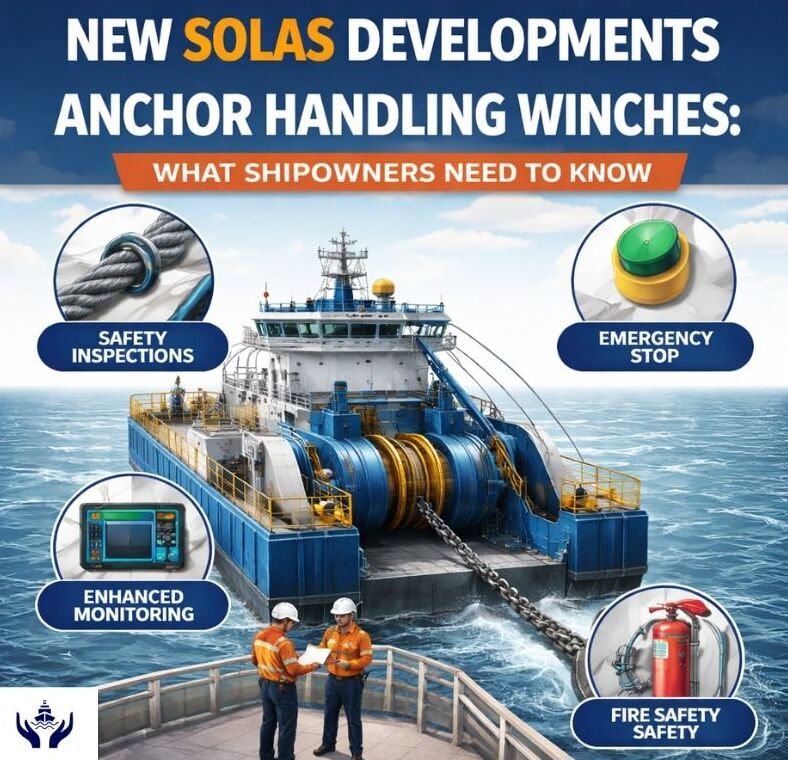
New SOLAS Developments for Anchor Handling Winches: What Shipowners Need to Know

Maritime safety is evolving — and anchor handling operations are now firmly in the regulatory spotlight. New SOLAS developments are raising the bar for winch safety on AHTS vessels.

Here is what shipowners need to understand about the changes, why they matter, and how to stay ahead.

Understanding the Regulatory Direction

The International Convention for the Safety of Life at Sea (SOLAS) sets the minimum safety standards for the construction, equipment, and operation of merchant ships. Enforced by flag states and supported by classification societies, SOLAS is the cornerstone of maritime safety worldwide.

Recent developments within the IMO and classification societies are placing increased focus on the safety of anchor handling equipment — particularly winches used on Anchor Handling Tug Supply (AHTS) vessels. The key focus areas include:

Equipment Strength & Design

  • Ensuring winches are designed and built to handle the extreme forces encountered during anchor handling operations
  • Load capacity ratings must be verified and clearly documented

Safe Operation & Failure Prevention

  • Operational procedures must minimize the risk of equipment failure under load
  • Inspection processes are being standardized to detect wear and defects before they become critical

The direction is clear: Anchor handling winch safety is no longer a matter of best practice alone — it is becoming a regulatory requirement with enforceable standards.

Why Anchor Handling Winches Matter

Anchor Handling Tug Supply (AHTS) vessels perform some of the most demanding and hazardous operations in the offshore sector. The winches on these vessels are subjected to extreme dynamic loads, sudden force changes, and harsh environmental conditions. When equipment fails during these operations, the consequences can be severe:

  • Crew injury or fatality — Snap-back incidents and uncontrolled line releases pose direct threats to personnel on deck
  • Vessel and rig damage — Winch failure can result in loss of control over anchors, leading to collisions or structural damage
  • Environmental incidents — Uncontrolled anchor movements can damage subsea infrastructure and cause pollution
  • Operational delays and financial losses — Equipment downtime, investigation costs, and insurance claims add up quickly

The bottom line: Anchor handling winches are safety-critical equipment. Their reliability directly impacts crew safety, asset protection, and operational continuity.

Key Areas of Focus

The evolving SOLAS framework and classification society requirements are converging on five critical areas for anchor handling winches:

Design & Load Capacity

Winches must be designed to withstand the maximum expected loads during anchor handling operations, with appropriate safety margins built into the design calculations.

Equipment Integrity

Structural integrity of winch components — including brakes, drums, shafts, and bearings — must be maintained throughout the equipment's service life through regular inspection and maintenance.

Testing & Verification

Load testing, brake holding capacity tests, and performance verification must be carried out at defined intervals and after any major repair or modification.

Documentation

Complete records of design specifications, test results, maintenance history, and operational limits must be maintained onboard and made available for survey and audit.

Surveys & Compliance Checks

Classification societies are introducing more rigorous survey requirements specifically for anchor handling equipment, including dedicated inspection checklists and condition assessments.

What About Existing Vessels?

A common question from shipowners is whether these new requirements apply only to newbuilds or also to vessels already in service. The answer is evolving:

  • Retroactive requirements are expanding — Classification societies are increasingly applying updated safety standards to existing vessels during class renewal surveys and annual inspections
  • Flag administrations are aligning — Many flag states are adopting the latest classification society guidance as part of their statutory survey requirements
  • Charterers and operators are raising the bar — Major oil companies and offshore operators are including winch safety assessments in their vetting and pre-hire inspections
  • Insurance implications — P&I clubs and hull underwriters are paying closer attention to anchor handling equipment condition as part of risk assessment

The trend is clear: Waiting for mandatory enforcement is no longer a safe strategy. Proactive compliance protects your vessels, your crew, and your commercial standing.

Practical Steps for Shipowners

Shipowners who act now will be better positioned to meet evolving requirements without disruption. Here are five practical steps to get started:

1. Conduct a Gap Assessment

Review your current anchor handling winch equipment against the latest classification society requirements and SOLAS guidance. Identify any gaps in design, condition, or documentation.

2. Engage with Classification Societies

Contact your classification society early to understand the specific requirements that apply to your vessel class and trading area. Early engagement avoids surprises during surveys.

3. Plan Upgrades & Modifications

If gaps are identified, develop a phased upgrade plan that aligns with your vessel's drydocking and survey schedule. Budget for necessary modifications and component replacements.

4. Improve Documentation

Ensure all winch-related documentation is complete, current, and readily accessible — including design specifications, test certificates, maintenance logs, and operational manuals.

5. Train Your Crew

Invest in crew training on safe winch operations, emergency procedures, and equipment inspection techniques. Well-trained crew are your first line of defense against equipment failure.

Looking Ahead

The direction of SOLAS and classification society developments is unmistakable: greater safety consistency across the anchor handling fleet. These developments are about:

  • Protecting crew and assets — Reducing the risk of accidents through better equipment standards and operational controls
  • Reducing operational risks — Minimizing the likelihood of equipment failure that leads to downtime, damage, or environmental incidents
  • Raising industry standards — Creating a level playing field where all operators meet the same safety benchmarks

Shipowners who embrace these changes early will gain a competitive advantage — through safer operations, lower insurance costs, improved charterer confidence, and reduced regulatory risk.

Conclusion

The new SOLAS developments for anchor handling winches represent a significant step forward in maritime safety. For shipowners, the message is clear: now is the time to act.

Proactive compliance is not just about meeting regulatory requirements — it is about protecting your crew, your vessels, and your business. Shipowners who take a forward-looking approach will be better positioned to navigate the evolving regulatory landscape with confidence.

Don't wait for enforcement — lead with safety. Assess your fleet, engage your classification society, and start building your compliance roadmap today.

Contact Us

Need help with SOLAS compliance, anchor handling winch assessments, or maritime safety consulting? Our experts at Varuna Sentinels BV are here to assist you.

Reach out to us at contact@varuna-sentinels.com or call us at +31 20 24 0355

Visit our website: www.varuna-sentinels.com