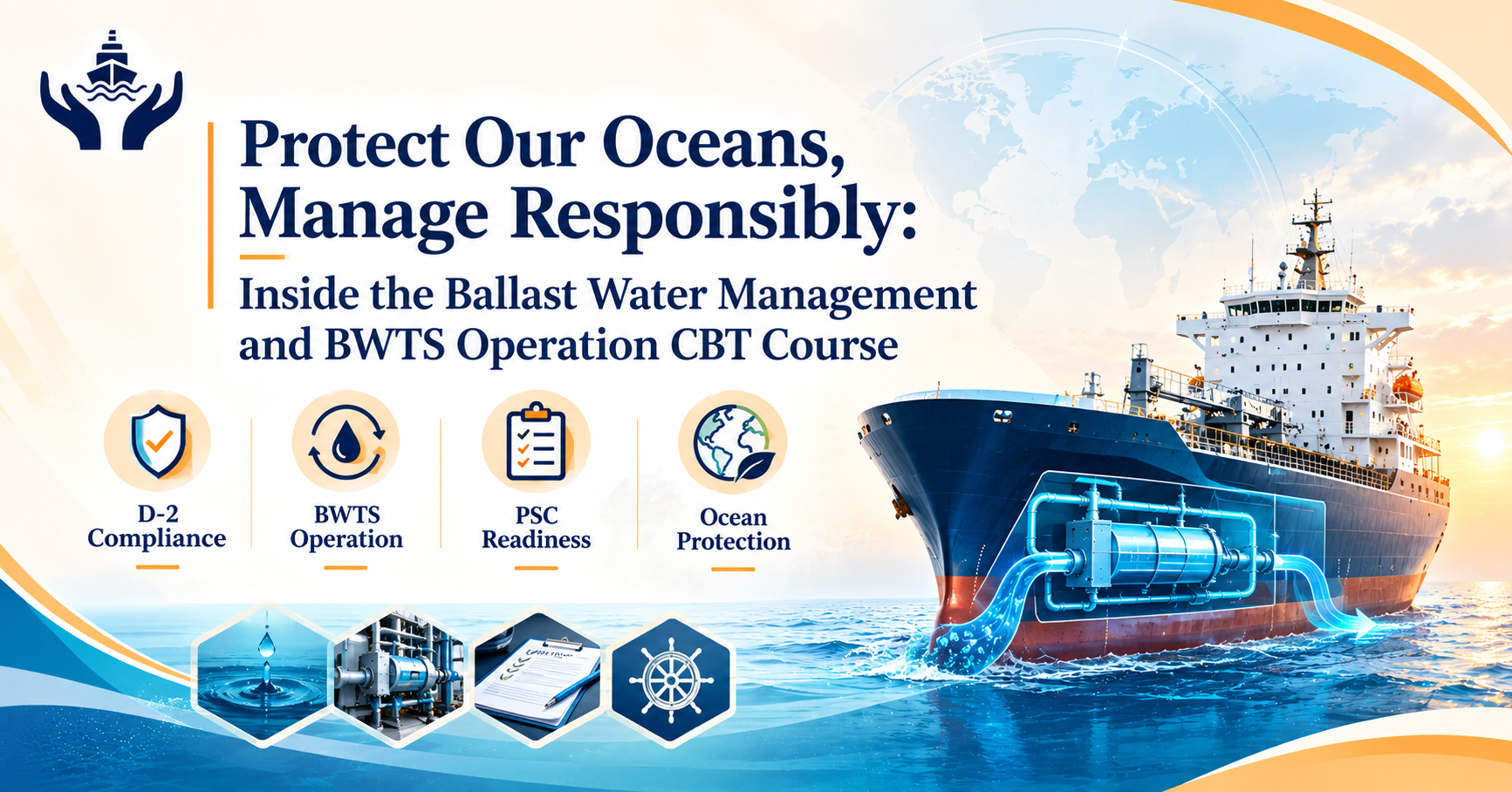
Protect Our Oceans, Manage Responsibly: Inside the Ballast Water Management and BWTS Operation CBT Course

Trained People Are a Compliance Requirement, Not an Optional Extra.

Every tonne of ballast water taken on in one port and discharged in another can carry living organisms far from home. The BWM Convention requires ships to manage it to defined standards — and requires the officers and crew to know their duties. This is the course built to close that gap.

Introduction: Why Ballast Water Management Matters

  • 12narrated modules with 3D practical scenes
  • 212minutes of lessons, about 3 hours 30 minutes
  • 136modules across 20+ courses in the VS CBT library
  • 12,000+seafarers trained from over 150 companies

Ballast water keeps a ship safe. It provides stability, trim and structural balance when cargo holds are empty or only partly loaded. But every tonne of sea water taken on in one port and discharged in another can also carry living organisms — plankton, larvae, bacteria and pathogens — that can establish themselves far from home. Billions of tonnes of ballast water move around the world every year, and the invasive species it has helped to spread are recognised as one of the major threats to the health of our oceans.

The International Convention for the Control and Management of Ships’ Ballast Water and Sediments (the BWM Convention) is the maritime industry’s answer. It requires ships to manage their ballast water to defined standards, to carry an approved Ballast Water Management Plan and a Ballast Water Record Book, and to prove compliance to Port State Control. The rules continue to tighten:

How the BWM rules have tightened
  • In force since 8 September 2017

    The BWM Convention requires ships to manage ballast water to defined standards and prove it to Port State Control.
  • D-2 applies to all ships

    The D-2 performance standard now applies to every ship, not just newbuilds.
  • New Record Book form

    A new Ballast Water Record Book form has been in force since 1 February 2025.

  • Electronic record books

    Electronic record books are now recognised by the IMO.
  • 2026 amendments and guidelines

    Further amendments and revised guidelines for ballast water management plans were approved in 2026.
  • Entry into force to be decided

    The date the 2026 amendments enter into force is still to be decided, so the requirements will keep moving.
1. Trained People Are a Compliance Requirement

Crucially, the Convention does not stop at equipment. Regulation B-6 requires officers and crew to be familiar with their ballast water management duties and with the ship’s own plan. In other words, trained people are a compliance requirement, not an optional extra.

Port State Control Port State Control is finding the same thing: in the joint 2025 Paris and Tokyo MoU inspection campaign on ballast water, the most frequent deficiency, and the most frequent cause of detention, was a simple question — “Is the ballast water management system operational?”

That is exactly the gap the Varuna Sentinels CBT course Ballast Water Management and BWTS Operation is designed to close, for Masters, Chief Officers, Chief and Second Engineers and officers in charge of ballast operations.

2. The Course at a Glance

The Ballast Water Management and BWTS Operation course at a glance
Item Details
Course Ballast Water Management and Ballast Water Treatment System (BWTS) Operation
Who it is for Masters, Chief Officers, Chief and Second Engineers and officers in charge of ballast operations; also technical superintendents and shore staff who support BWM compliance
Level Starts in plain English from first principles, so no prior ballast water knowledge is needed, and builds to the operational and compliance depth that inspections test
Category Environmental
Format 12 narrated lessons with 3D practical scenes, on-screen summaries, practice scenarios and a quiz in every module
Length About 3 hours 30 minutes of lessons (212 minutes), plus study and assessment time
Delivery Self-paced Computer-Based Training, accessible on board or ashore
Assessment A knowledge check in every module, scored scenarios, a record-book entry task and a final test
Outcome A Varuna Sentinels Certificate of Completion, issued under our ISO 9001 quality management system certified by DNV, for training records
How to start Enrol directly on the Varuna Sentinels CBT platform or use Enquire Now for fleet licences

Swipe or scroll the table sideways to see every column.

Please note: this course is generic training. It does not replace maker training on the ballast water treatment system fitted to your ship.

3. What the Course Includes

The course follows the complete ballast cycle on board — intake, treatment and discharge — and ties each step back to the regulation that governs it. It is structured so that an officer can move from understanding why the Convention exists to knowing exactly what must be done, recorded and demonstrated on their own vessel. It has 12 modules in three groups.

The ballast cycle the course follows

  • Intake
  • Treatment
  • Discharge
  • Record & Demonstrate
The 12 modules of the course
Module What you learn
1Ballast Water and Invasive Aquatic Species Why ships carry ballast water; how organisms and pathogens are transferred; well-known invasions; sediments; the environmental, health and economic impact.
2The BWM Convention Framework Adoption and entry into force; structure and scope; application, exceptions and exemptions; surveys and certification; the Convention review.
3D-1 and D-2 Standards and Compliance The D-1 exchange standard and methods, including the 95 per cent volumetric exchange requirement; the D-2 performance standard; the implementation schedule; national and regional requirements.
4BWMS Technologies and Their Limits Filtration, UV treatment, electrochlorination and chemical injection; neutralisation and total residual oxidant; holding times; system limitations and hazards.
5Type Approval, the BWMS Code and System Design Limitations IMO and USCG type approval; the Type Approval Certificate; system design limitations; operating within approved conditions.
6BWMS Operation: Ballasting and Deballasting Pre-operation checks; start-up and line-up; monitoring during ballasting; holding time; deballasting and neutralisation; alarms and bypass; stripping and shutdown.
7Maintenance, Commissioning and Self-Monitoring Planned maintenance; UV lamps, filters, electrodes and sensors; calibration; spares; commissioning testing; proving that the system works.
8The Ballast Water Management Plan Purpose and approval of the plan; required contents; the 2026 guidelines; ship-specific procedures; sediment management; duties of the officer in charge and the crew.
9Ballast Water Record Book and Reporting Regulation B-2; the current form of the Record Book; making correct entries; electronic record books; retention; port State reporting forms.
10Contingency Measures and Challenging Water Quality What to do when the system cannot be used or fails; contingency options; communication with the port State; recording contingency actions.
11Port State Control, Sampling and Common Deficiencies How a PSC ballast water inspection proceeds; documents checked; crew familiarity; sampling and indicative analysis; common deficiencies and how to avoid them.
12Safety, Crew Responsibilities and Course Assessment Hazards of treatment systems and ballast operations; enclosed spaces and tank entry; stability and stress; responsibilities on board; an integrated scenario and the final assessment.

Swipe or scroll the table sideways to see every column.

Is the Ballast Water Management System Operational?

The most frequent PSC deficiency and cause of detention in the 2025 Paris and Tokyo MoU campaign — and a question every trained officer should be able to answer with confidence.

4. Key Benefits

Training in ballast water management pays for itself the first time a Port State Control officer asks to see your system running and your record book. The course delivers value at ship, company and fleet level:

  • 1

    Fewer PSC findings

    Inspectors check three things above all: that the system is operational, that the crew know the plan, and that the Record Book is correct. The course teaches all three, including what to record and when.

  • 2

    Fewer system failures and bypass events

    Industry data reported from Australia linked about 70 per cent of non-compliance reports to crew unfamiliarity with the plan and poor maintenance, including ignored alarms and sensor failures. Crews who understand their system, its limits and its contingency procedures keep it running and know what to do when it cannot.

  • 3

    Documented familiarisation under Regulation B-6

    The certificate of completion supports the ship’s training records and the company’s familiarisation requirements under Regulation B-6 and the ISM Code, something flag and port authorities increasingly ask about.

  • 4

    Safer operations

    Ballast exchange and treatment affect stability, hull stress and tank integrity. A full module on safety and enclosed spaces makes the precautions second nature.

  • 5

    Genuine environmental protection

    Correct management prevents the transfer of invasive species, supporting the company’s environmental commitments and ESG reporting.

  • 6

    Flexible, self-paced delivery

    Officers complete the course on board or at home, around their watch schedule, without travel or classroom time.

  • 7

    Consistency across the fleet

    Every vessel receives the same up-to-date content, so standards do not depend on which officer happened to attend which seminar.

5. Why You Should Opt for This Course

There are many BWM courses on the market. This one has been built with a clear idea of who will take it and what they need to walk away with.

  • Role-specific

    It is written for the people who carry the compliance responsibility on board and ashore, not as a general awareness course.

  • Clear for everyone

    It starts in plain English and builds to operational and record-keeping depth. A new officer can follow it, and an experienced officer will still find the detail that inspections actually test.

  • Current

    The content reflects the D-2 standard applying to all ships, the current Ballast Water Record Book form, electronic record books and the 2026 amendments and guidelines. It will be updated when the entry-into-force date is set.

  • Practical, not academic

    Narrated 3D practical scenes follow the real ballast cycle — intake, treatment, discharge — and show the control panel, the Record Book and the inspection, linking every regulatory requirement to the action the officer must take.

  • Part of a proven platform

    The Varuna Sentinels CBT library offers 136 modules across 20+ courses and has been used by more than 12,000 seafarers from over 150 companies.

  • Easy to roll out

    Individual officers can enrol online in minutes; companies can license the course across their fleet and track completion centrally.

Conclusion: From Future Obligation to Daily Reality

The BWM Convention has moved from a future obligation to a daily reality. Treatment systems are installed, the D-2 standard applies to all ships, the Record Book has changed, and Port State Control knows exactly where to look. What decides whether a vessel sails on time or sits in port is no longer only the hardware — it is whether the officers responsible understand the rules, operate the system correctly and keep records that stand up to inspection.

The Ballast Water Management and BWTS Operation CBT course gives Masters, Chief Officers, engineers and BWM officers that understanding in a format that fits around life at sea. Enrol today on the Varuna Sentinels CBT platform or contact us to discuss a fleet-wide licence.

Contact Us

Preparing your officers for their next Port State Control ballast water inspection? Our team at Varuna Sentinels BV can set up the Ballast Water Management and BWTS Operation CBT course for individual officers or across your fleet — with centrally tracked completion and a Certificate of Completion for every candidate’s training records.

Reach out to us at contact@varuna-sentinels.com or call us at +31 20 24 0355

Share this page with your maritime team
LinkedIn Post WhatsApp Email

Latest from our Recent Events

Our newest videos — auto-updating straight from the Varuna Sentinels YouTube channel.

Real-Time Marine Intelligence

Follow Varuna Sentinels BV

IHM Maintenance, HKC, EUSRR, MEPC, PFAS, FuelEU & LCA — delivered the moment we publish. Join the global maritime community across all five VS channels.