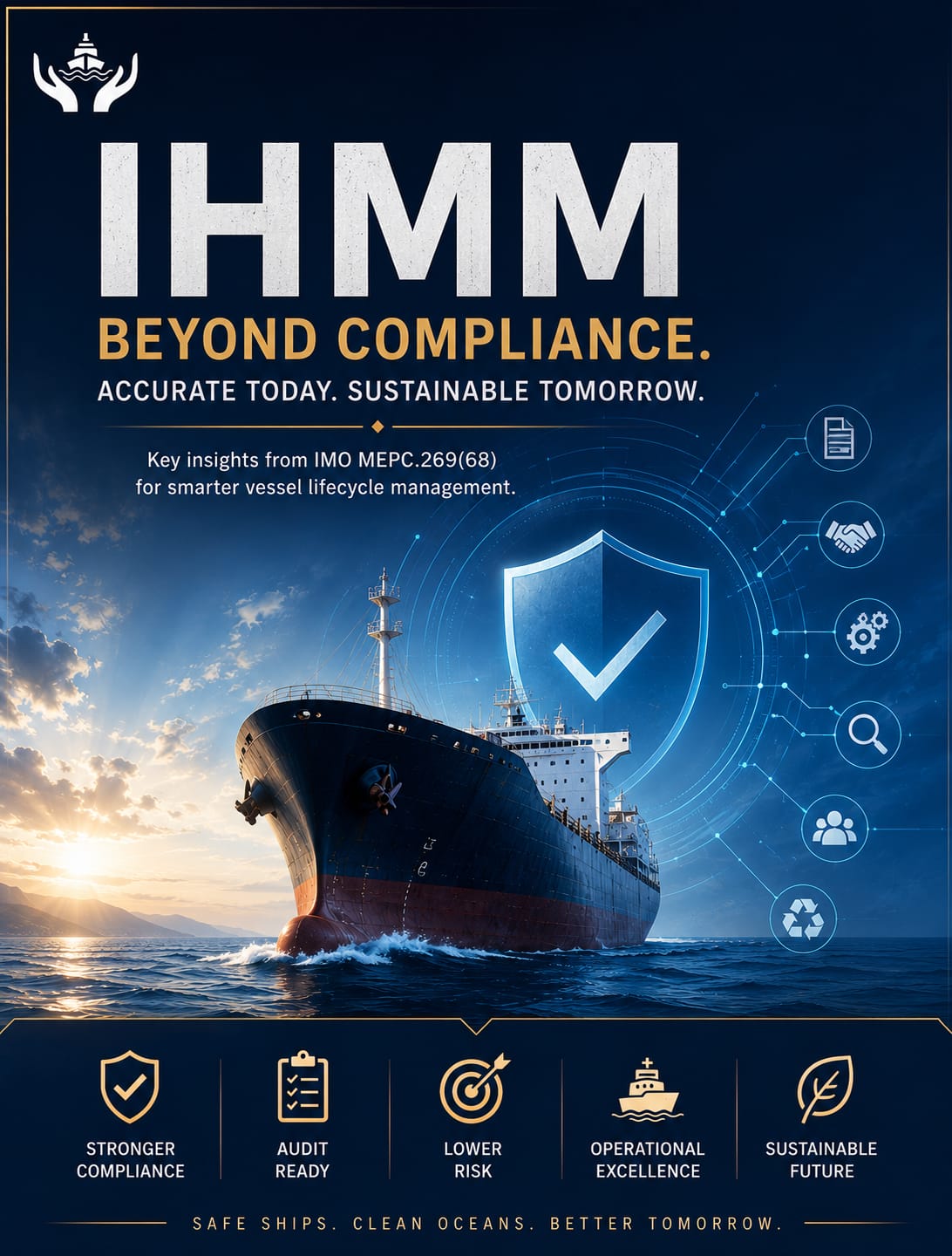
Beyond Compliance: 7 Critical Insights from IMO MEPC.269(68) That Every Shipowner Should Know About IHMM

Maintaining an accurate Inventory of Hazardous Materials (IHM) is no longer a one-time exercise — it is a continuous, lifecycle responsibility that protects compliance, inspection readiness and value.

Discover how Varuna Sentinels B.V. applies the principles of IMO Resolution MEPC.269(68) to keep hazardous material records accurate, audit-ready and inspection-proof throughout a vessel’s service life.

Why IHMM Matters

As the maritime industry embraces stricter environmental regulations and prepares for sustainable ship recycling, maintaining an accurate Inventory of Hazardous Materials (IHM) has become an ongoing operational responsibility rather than a one-time compliance exercise. While IMO Resolution MEPC.269(68) provides comprehensive guidelines for developing the IHM, it also highlights the importance of ensuring that the Inventory remains accurate throughout a vessel’s operational life.

At Varuna Sentinels B.V., we refer to this continuous process as Inventory of Hazardous Materials Maintenance (IHMM) — a structured approach to reviewing, updating and maintaining the Inventory whenever changes occur onboard. By adopting this lifecycle approach, shipowners can reduce compliance risks, improve inspection readiness and ensure that hazardous material records accurately represent the vessel at every stage of its service.

In this article: seven key insights from IMO MEPC.269(68) that every shipowner, technical manager, superintendent and procurement team should understand — and how they translate into effective, day-to-day IHMM.

The Seven Insights at a Glance

1. A Living Document

The Inventory should evolve with the vessel, not sit untouched between surveys.

2. Supplier Documentation

MDs and SDoCs are the foundation of an accurate, defensible Inventory.

3. Every Retrofit Triggers a Review

Modifications and replacements should prompt an Inventory update.

4. Handling “Unknowns”

Gaps are managed through a structured process, not assumptions.

5. Documentation Quality

Structured, traceable records matter as much as technical accuracy.

6. A Supply-Chain Effort

Accurate information is collected across the entire supply chain.

7. The Five-Step Methodology

A practical framework for maintaining the Inventory for life.

1. The Inventory Is a Living Document, Not a One-Time Certification

One of the most important messages conveyed by MEPC.269(68) is that an Inventory should evolve together with the vessel. Throughout a ship’s lifecycle, machinery is replaced, electrical systems are upgraded, coatings are renewed, accommodation spaces are refurbished and new equipment is installed. Each of these modifications has the potential to introduce new hazardous materials or remove existing ones.

The guideline recognises that these operational changes directly affect the hazardous material profile of the vessel. Therefore, maintaining an accurate Inventory requires periodic reviews whenever modifications, repairs or equipment replacements occur.

Treating the Inventory as a document that is only reviewed during surveys or prior to recycling can result in outdated information — creating unnecessary challenges during inspections, vessel sales, class surveys and eventual recycling.

Key takeaway: An Inventory should continuously evolve alongside the vessel. Effective IHMM ensures that every significant onboard modification is accurately reflected within the Inventory.

2. Supplier Documentation Is the Foundation of an Accurate Inventory

One of the strongest themes within MEPC.269(68) is the importance of collecting reliable information from equipment manufacturers and suppliers. The guideline recommends obtaining Material Declarations (MDs) together with Supplier’s Declarations of Conformity (SDoCs) as primary sources of hazardous material information.

These documents support the document analysis process and reduce uncertainty when identifying hazardous substances contained in equipment and materials supplied to the vessel. They also minimise the need for extensive onboard inspections or sampling during future Inventory updates.

Every replacement pump, valve, cable, navigation system, insulation material, coating or electrical component installed onboard should ideally be accompanied by the appropriate supplier documentation. Without these records, determining hazardous material content becomes significantly more challenging over time.

Key takeaway: Hazardous material management begins long before equipment reaches the vessel. A structured process for collecting and managing MDs and SDoCs forms the foundation of effective IHMM.

3. Every Retrofit Should Trigger an Inventory Review

Ships rarely remain unchanged throughout their operational life. Dry dockings, ballast water treatment system installations, exhaust gas cleaning systems, alternative fuel conversions, machinery replacements, electrical upgrades and accommodation refurbishments all introduce new materials onboard.

While these projects are often completed successfully from an engineering perspective, the associated hazardous material documentation is sometimes overlooked. As a result, the Inventory gradually becomes inconsistent with the vessel’s actual configuration.

MEPC.269(68) encourages shipowners to review the Inventory whenever modifications or equipment replacements occur, to determine whether hazardous material records require updating. By integrating Inventory reviews into retrofit planning, shipowners can avoid costly documentation gaps that often become apparent only during inspections or recycling preparations.

Key takeaway: Every retrofit, repair or equipment replacement should trigger an Inventory review to determine whether hazardous material records require updating.

4. “Unknown” Materials Should Be Assessed Through a Structured Process

One of the most practical sections of MEPC.269(68) addresses situations where hazardous material content cannot be confirmed through available documentation. This is particularly common on older vessels, where historical records may be incomplete.

Rather than making assumptions, the guideline recommends a systematic approach. Shipowners should first assess available documentation before deciding whether additional visual inspections or sampling are required. Where sampling is impractical or disproportionately expensive, components may be classified as potentially containing hazardous materials, provided suitable technical justification is documented.

This pragmatic methodology allows compliance to be achieved while avoiding unnecessary dismantling of equipment solely for sampling purposes.

  • Assess available documentation — start with what is already known
  • Carry out visual inspection — where documentation is insufficient
  • Apply targeted sampling — only where necessary and proportionate
  • Use justified classification — with documented technical reasoning where sampling is impractical

Key takeaway: Documentation gaps should be managed through document analysis, visual inspections, targeted sampling or justified classification — not through assumptions.

5. Documentation Quality Is Just as Important as Technical Accuracy

Preparing an Inventory involves much more than identifying hazardous materials. MEPC.269(68) recommends maintaining structured checklists that record equipment locations, hazardous material types, supporting reference documents, quantity calculations, document analysis results and inspection findings.

Consistent documentation enables technical managers, surveyors and recycling facilities to understand exactly where hazardous materials are located and how conclusions were reached. Well-organised records also simplify future Inventory updates and significantly improve inspection efficiency.

Key takeaway: A technically accurate Inventory is only effective when supported by clear, structured and traceable documentation.

6. Information Collection Extends Across the Entire Supply Chain

Another important lesson from MEPC.269(68) is that hazardous material information does not originate onboard the vessel — it originates throughout the supply chain.

Equipment manufacturers, suppliers, procurement teams, shipyards, technical departments and vessel managers all contribute to the collection of information required for maintaining an accurate Inventory. A missing Material Declaration or Supplier’s Declaration of Conformity may appear insignificant during procurement, but can create considerable challenges years later when updating the Inventory or preparing for recycling.

Building a structured process for collecting supplier information ensures long-term documentation quality and reduces future compliance risks.

Key takeaway: Effective IHMM depends on timely information collection and collaboration between all stakeholders involved in vessel procurement and maintenance.

7. The Five-Step Methodology Supports Continuous Inventory Maintenance

One of the most overlooked aspects of MEPC.269(68) is its structured five-step methodology for developing and maintaining an Inventory. The guideline recommends:

  • Step 1 — Collect all available documentation
  • Step 2 — Assess the information collected
  • Step 3 — Plan a visual and sampling check
  • Step 4 — Verify onboard where necessary
  • Step 5 — Prepare or update the Inventory based on verified findings

Although these steps are presented for developing the Inventory, they also provide an effective framework for Inventory of Hazardous Materials Maintenance (IHMM) throughout the vessel’s operational life. By applying this methodology whenever significant modifications occur, shipowners can maintain an Inventory that accurately reflects the vessel while reducing future compliance efforts.

Key takeaway: The five-step methodology of MEPC.269(68) is not only a guide for preparing an Inventory — it is a practical framework for maintaining one throughout the vessel lifecycle.

The IHMM Advantage

Applied consistently, the principles of MEPC.269(68) turn day-to-day IHM Maintenance into five clear, lasting benefits for every vessel in your fleet:

Stronger Compliance

Records that always reflect the vessel and stand up to scrutiny.

Audit Ready

Structured, traceable documentation ready for inspections at any time.

Lower Risk

Fewer documentation gaps, surprises and costly delays down the line.

Operational Excellence

Inventory reviews built into retrofits, repairs and dry dockings.

Sustainable Future

Safer, cleaner and more sustainable ship recycling at end of life.

How Varuna Sentinels B.V. Supports Shipowners

At Varuna Sentinels B.V., we believe that effective hazardous material management extends far beyond preparing an Inventory. Our Inventory of Hazardous Materials Maintenance (IHMM) services are built around the lifecycle principles outlined in IMO Resolution MEPC.269(68).

  • Reviewing Material Declarations (MDs) and verifying Supplier’s Declarations of Conformity (SDoCs)
  • Assessing technical documentation for hazardous material content
  • Updating Inventories following retrofits, repairs and equipment replacements
  • Ensuring hazardous material records remain accurate and audit-ready throughout the vessel’s operational life

By following the document collection, assessment, verification and Inventory updating methodology recommended in MEPC.269(68), we help shipowners strengthen compliance, simplify inspections and support safer, more sustainable ship recycling.

From obligation to advantage: continuous IHMM turns a periodic compliance task into a reliable, always-current record that supports inspections, sales, class surveys and recycling alike.

Conclusion

IMO Resolution MEPC.269(68) is far more than a guideline for preparing an Inventory of Hazardous Materials — it provides a practical methodology for managing hazardous material information throughout a vessel’s lifecycle.

The seven insights discussed above demonstrate that successful Inventory of Hazardous Materials Maintenance (IHMM) depends on continuous documentation, structured information collection, systematic assessment and proactive updates following every significant onboard modification.

Compliance as an advantage: For shipowners, adopting these practices transforms compliance from a periodic obligation into a long-term operational advantage — enhancing efficiency and contributing to a safer, more sustainable future for global shipping.

Contact Us

Want to keep your Inventory of Hazardous Materials accurate, inspection-ready and aligned with MEPC.269(68) throughout your fleet’s lifecycle? Our experts at Varuna Sentinels B.V. are here to help you implement effective IHM Maintenance (IHMM).

Reach out to us at contact@varuna-sentinels.com or call us at +31 20 24 0355

Visit our website: www.varuna-sentinels.com

Share this article

LinkedIn Twitter Email

Related Articles

Managing IHM Maintenance for Mixed-Fleet Ships

Read More

Common Errors in IHM Part I Maintenance and How to Avoid Them

Read More

Hong Kong Recycling Convention

Read More

Ready to keep your IHM accurate and audit-ready?

Schedule a Meeting Contact Us