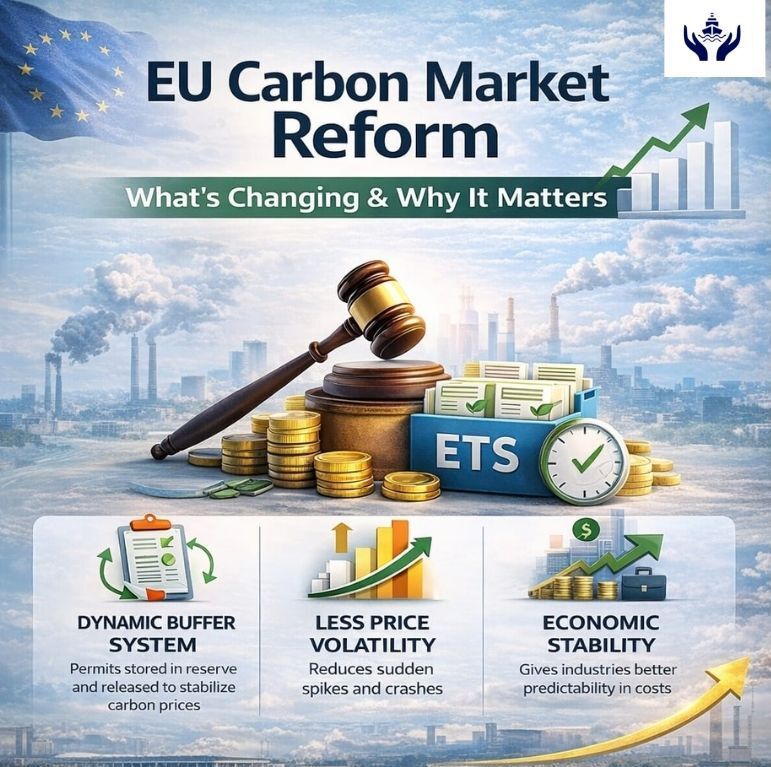
EU Carbon Market Reform: What's Changing, Why It Matters & What Comes Next

The European Union has initiated its first step in reforming the EU Emissions Trading System (ETS) — not to weaken climate action, but to make it more stable, predictable, and resilient.

Let's break down the real changes, how they work, and what they mean for businesses.

Understanding the Core Change (What & How)

At the heart of this reform is the Market Stability Reserve (MSR) — a mechanism designed to manage the supply of carbon allowances in the market.

How the System Worked Earlier

  • If too many carbon permits were in circulation, the MSR removed them
  • If supply crossed a limit (~400 million permits), they were permanently cancelled
  • This reduced supply and pushed carbon prices upward

What Is Changing Now

  • The EU will stop permanently cancelling excess permits
  • Instead, permits will be stored in the MSR as a reserve (buffer)
  • Permits will be released back into the market when needed

This effectively creates a "shock absorber" for carbon prices:
Too many permits? Store them. Too few permits? Release them.

This change strengthens the system's ability to handle market volatility without disrupting long-term climate goals.

Why This Reform is Happening

The reform is driven by a need to balance climate ambition with economic reality:

  • Rising and unpredictable energy prices
  • Geopolitical uncertainties impacting markets
  • Industry concerns over high carbon costs and competitiveness
  • Need for a more stable and predictable carbon price signal

At the same time, the EU wants to retain the ETS as a key climate tool, which has already contributed significantly to emission reductions.

In simple words: This is not about reducing ambition — it's about making the system more practical and stable.

What Are the Benefits?

Short-Term Benefits

Reduces Volatility

Reduces carbon price volatility and prevents sudden price spikes or crashes

Cost Predictability

Provides cost predictability for businesses, enabling better financial planning

Investment Confidence

Helps industries plan investments with greater confidence in carbon costs

Long-Term Benefits

Decarbonization Incentives

Maintains strong decarbonization incentives and improves carbon market resilience

Clean Energy Transition

Supports clean energy transition investments and sustainable technology adoption

EU 2030 Targets

Aligns with EU's broader target of reducing emissions by at least 55% by 2030

What This Means Going Forward

This is just the first phase of a broader reform.

  • A comprehensive ETS review is expected by July 2026
  • More structural changes may follow to further strengthen the system

The direction is clear: The EU is moving toward a more flexible, adaptive carbon pricing system.

Why This Matters for ESG & Sustainability Professionals

This reform signals an important shift:

  • Carbon markets are becoming more dynamic and policy-driven
  • Stability is now as important as price signals
  • Businesses must prepare for evolving regulatory mechanisms
  • ESG strategy needs to factor in carbon price uncertainty and policy changes

Final Thought

The EU ETS reform shows that climate policy is entering its next phase — not just ambitious, but intelligently designed.

The focus is shifting from: "Strict control" to "Smart control"

For businesses and sustainability professionals, the message is clear: Understanding policy mechanics is now just as important as setting climate targets.

References

Contact Us

Need help with EU ETS compliance, carbon market strategy, or ESG reporting? Our experts are here to assist you.

Reach out to Varuna Sentinels BV at contact@varuna-sentinels.com or visit our website www.varuna-sentinels.com