
Material Declarations & Supplier Data: The Hidden Challenge in IHM Maintenance

Why supplier documentation is the weak link in continuous IHM compliance — and how to capture it at the point of purchase.

For shipowners and ship managers, one of the most difficult parts of IHM maintenance is obtaining, validating, organising and retaining reliable information from the supplier network — above all the Material Declaration (MD) and the Supplier’s Declaration of Conformity (SDoC).

Introduction: A New Phase of IHM Lifecycle Management

  • 2025Hong Kong Convention in force since 26 June 2025
  • 2documents at the centre — the MD and the SDoC
  • 7stages in a practical IHM maintenance workflow
  • 1connected record from purchase order to IHM Part I

The maritime industry has entered a new phase of Inventory of Hazardous Materials (IHM) lifecycle management. With the Hong Kong International Convention for the Safe and Environmentally Sound Recycling of Ships entering into force on 26 June 2025, the importance of maintaining an accurate and updated IHM throughout the vessel lifecycle has increased significantly.

For shipowners and ship managers, one of the most difficult parts of this process is obtaining, validating, organising and retaining reliable information from the supplier network. At the centre of this challenge are two important documents: the Material Declaration (MD) and the Supplier’s Declaration of Conformity (SDoC).
1. Why Supplier Data Has Become an IHM Challenge

IHM Part I covers relevant fixed machinery, equipment, materials and coatings installed on board. When relevant products are purchased and installed, the shipowner or manager needs appropriate information from suppliers so that the vessel’s IHM can be assessed and, where necessary, updated.

Example A vessel replaces an old pump during dry-docking. The procurement team may consider the transaction complete when the pump is delivered. From an IHM perspective, however, the process continues. The ship manager needs to determine whether the pump is relevant to IHM Part I, obtain the appropriate MD/SDoC documentation, connect the information to the specific equipment and location, and ensure that the IHM record is updated when required.

This illustrates the difference between procurement completion and compliance completion: the product can be physically delivered while the IHM evidence chain is still incomplete.

2. The Supplier-to-IHM Data Chain

A reliable IHM process can be understood as a connected data chain rather than a collection of separate documents.

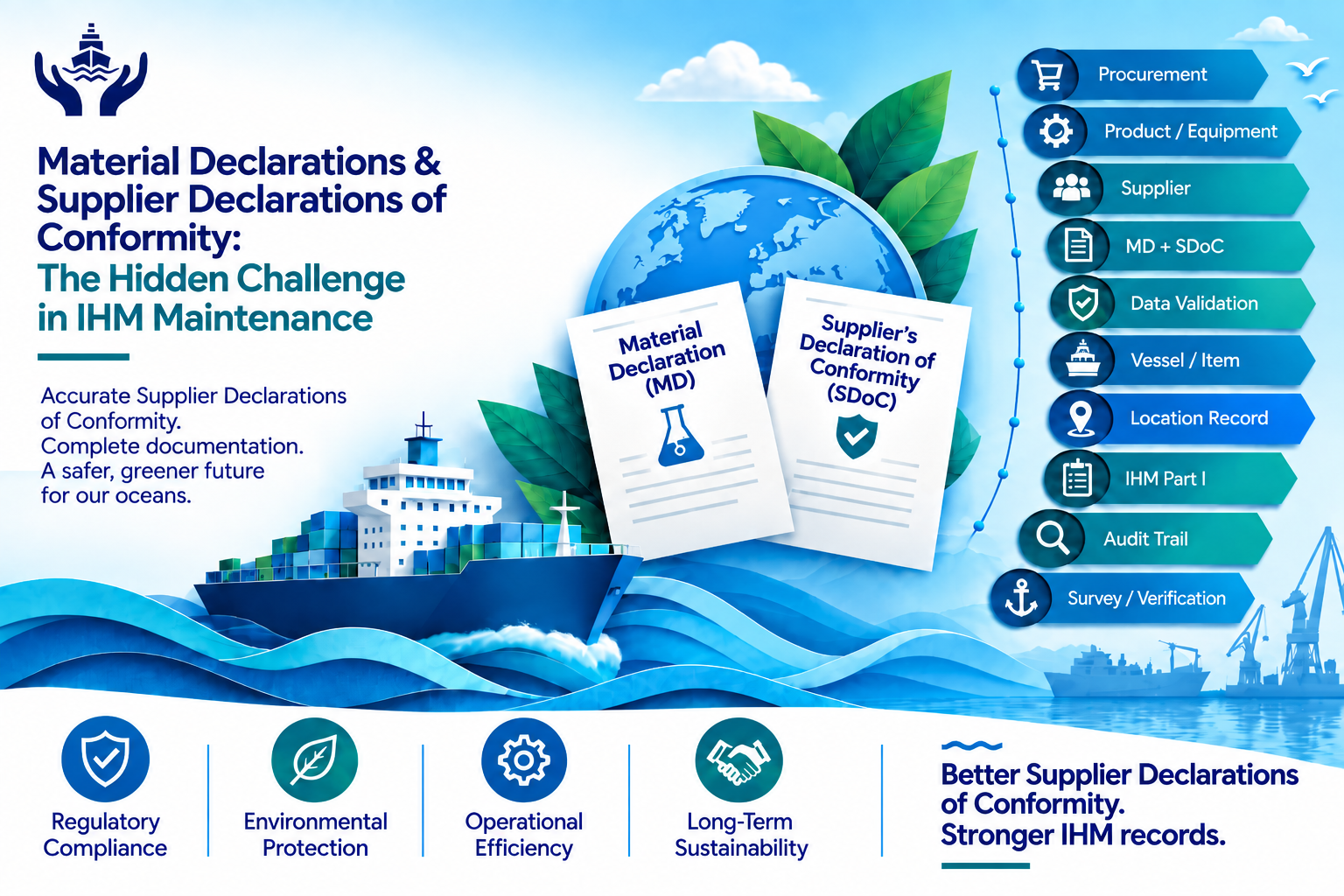
The supplier-to-IHM data chain

  • Procurement
  • Product / Equipment
  • Supplier
  • MD + SDoC
  • Data Validation
  • Vessel / Item
  • Location Record
  • IHM Part I
  • Audit Trail
  • Survey / Verification

Example If a replacement valve is purchased, the relevant supplier documentation should not remain disconnected from the purchase record. The valve’s product identity, supplier information, declaration and onboard location should ultimately be traceable to the IHM record.

3. What Are Material Declarations and SDoCs?

The documents behind a maintained IHM
Document Primary Purpose Why It Matters
Material Declaration (MD) Declares relevant hazardous-material information associated with a product. Provides supporting material information for IHM assessment and maintenance.
Supplier’s Declaration of Conformity (SDoC) Provides supplier assurance concerning the associated declaration and identifies the responsible entity. Strengthens accountability and the evidence supporting the supplier’s information.
IHM Part I Consolidates relevant hazardous-material information for the vessel. Provides the vessel-specific inventory required for applicable compliance.
Change / Audit Record Records IHM maintenance activities and changes. Helps demonstrate that the IHM is actively maintained and traceable.

Swipe or scroll the table sideways to see every column.

4. Why Collecting MDs Is Not as Simple as It Sounds

A vessel can work with hundreds or thousands of suppliers, manufacturers, distributors and service providers during its operational life. Documentation may therefore pass through several layers before it reaches the ship manager.

Example A ship manager purchases an electrical panel through a distributor. The distributor may not manufacture the panel and may need to obtain the required material information from the original manufacturer. If the documentation is not requested at the procurement stage, the IHM team may later have to chase several parties to reconstruct the evidence.

Where supplier documentation typically breaks down

  • Missing documents

    The product arrives without the expected MD or SDoC.

  • Incorrect or incomplete documents

    Product identifiers, supplier information or material information may not be sufficient.

  • Inconsistent formats

    Suppliers may use different templates and document structures.

  • Delayed responses

    Procurement may receive the product before the supporting compliance information.

  • Poor traceability

    It may be difficult to determine which declaration belongs to which product.

  • Fragmented records

    Information can become dispersed across emails, spreadsheets and vessel folders.

  • IHM update delays

    Equipment may be installed before the corresponding IHM review is completed.

5. The Real Problem: Data Fragmentation

The underlying challenge is often not the absence of a document, but the absence of a connected record. A PDF saved in a folder does not by itself explain which purchase, product, vessel, location and IHM entry it supports.

Traditional workflow

  • Supplier Email
  • PDF MD
  • Procurement Folder
  • Email to Vessel
  • Spreadsheet
  • IHM Manager
  • Manual Update
  • Survey Preparation

A structured workflow is more robust

  • Supplier
  • Digital MD / SDoC
  • Validation
  • Product Identification
  • Vessel / Location Mapping
  • IHM Database
  • Change / Audit Log
  • Survey-Ready Records

Example If ten similar valves are supplied to different vessels, a document-management approach may store ten PDFs. A traceability-focused approach should additionally identify the exact product, supplier, vessel, location, installation status and associated IHM record.

6. Where Varuna Sentinels BV Fits In

This supplier-data challenge is directly connected to Varuna Sentinels BV’s IHM Maintenance offering. Varuna’s VSIMS approach is designed to support the collection and management of MDs and SDoCs and the tracking of relevant hazardous-material items through their onboard lifecycle.

The value of such a system extends beyond document storage. The objective is to connect supporting evidence with the actual vessel item, its installation history and subsequent IHM maintenance actions.

Supplier data into VSIMS

  • Supplier
  • MD + SDoC
  • VSIMS
  • Validation / Record
  • Vessel / Location
  • IHM Part I
  • Change Tracking
  • Audit Trail

Example When a replacement pump is delivered, its supporting supplier documentation can be associated with the product and vessel record. If the pump is later removed, the lifecycle history can help establish what happened to that item and what IHM action was taken.

Capture It When the Change Happens

Connect every MD and SDoC to the product, the vessel and its onboard location — so the evidence behind each IHM data point is already there when it is needed.

7. From Document Collection to Data Traceability

A mature IHM maintenance process should be capable of answering several basic questions.

  • Product

    What exactly was purchased or installed?

  • Supplier

    Who supplied it and who is responsible for the declaration?

  • Documentation

    Where are the relevant MD and SDoC records?

  • Material

    What relevant hazardous-material information has been declared?

  • Vessel

    Which vessel received the item?

  • Location

    Where was the item installed?

  • Status

    Is the item still onboard, replaced or removed?

  • History

    When did the change occur and what action followed?

  • IHM

    Was the IHM reviewed and updated where required?

8. The Connection Between Procurement and IHM

Procurement and IHM have traditionally been treated as separate functions. Operationally, however, procurement is often the point at which the information needed for future IHM maintenance is first created.

Example Consider a vessel purchasing a new compressor. If the procurement workflow captures the supplier, exact product reference, relevant compliance documentation and delivery details from the beginning, the IHM team has a much stronger foundation for its subsequent review. If those details are lost between procurement and vessel operations, the same information may have to be reconstructed later.

This leads to an important concept: Procurement-to-IHM Traceability. Instead of asking the IHM team to chase documents after equipment has been installed, relevant documentation requirements can be incorporated into the procurement workflow.

9. How VSMPS Can Strengthen the Ecosystem

This is where Varuna’s VSMPS maritime procurement platform becomes strategically relevant. VSMPS addresses the procurement and supplier side of the maritime supply chain, while VSIMS addresses IHM maintenance and hazardous-material information.

Marine supplies being loaded alongside a vessel

VSMPS — Procurement & Supplier Side

  • Supplier onboarding and procurement
  • Product and supplier data
  • MD / SDoC requested as part of the supplier and product-data workflow
Engineers working on deck machinery aboard a vessel

VSIMS — IHM Maintenance Side

  • Collection and management of MDs and SDoCs
  • Tracking of hazardous-material items through their onboard lifecycle
  • IHM Part I, change tracking and audit trail

A potential connected workflow

  • VSMPS
  • Supplier Onboarding / Procurement
  • Product Data
  • MD / SDoC
  • VSIMS
  • IHM Part I
  • Traceability / Audit

Example During procurement of a fixed equipment item, supplier documentation can be requested as part of the broader supplier and product-data workflow. Once the relevant information is available, it can support the IHM review and maintenance process. The level of system integration should always be aligned with the actual functionalities available and implemented within the deployed solution.

10. Why This Matters Under the Hong Kong Convention

The key change is the move toward continuous IHM maintenance. The practical question is no longer simply whether a vessel has an IHM certificate. Shipowners and managers increasingly need to demonstrate that relevant changes are identified, supported by appropriate evidence and reflected in the maintained IHM.

  • Yesterday’s questionDo we have an IHM?
  • Today’s questionIs our IHM maintained?
  • The stronger future questionCan we trace the evidence behind each relevant IHM data point?

Example A vessel may have received an IHM several years ago. Since then, dozens of pieces of equipment may have been replaced. If supplier documentation was not systematically captured, the ship manager may have difficulty demonstrating the history of those changes. A continuous process avoids this information gap.

11. Manual vs Digital IHM Maintenance

Traditional compared with a structured digital approach
Area Traditional Approach Structured Digital Approach
Supplier communication Email-based follow-up Structured workflow
MD/SDoC collection Manual chasing Centralised collection and records
Document storage Folders / email attachments Digital repository linked to records
Product tracking Spreadsheets Item-level tracking
Vessel/location Manual records Structured mapping
IHM updates Manual and reactive Workflow-supported maintenance
Change history Difficult to reconstruct Traceable audit history
Survey preparation Often reactive Continuous readiness

Swipe or scroll the table sideways to see every column.

12. A Practical Seven-Stage IHM Maintenance Workflow

  • 1

    Identify

    Determine whether the purchased or installed item is relevant to the applicable IHM requirements.

  • 2

    Request

    Obtain the appropriate MD and SDoC information from the supplier.

  • 3

    Validate

    Check supplier, product and declaration information.

  • 4

    Record

    Connect the documentation to the specific product or equipment.

  • 5

    Locate

    Record the onboard location and relevant vessel information.

  • 6

    Update

    Assess and implement the necessary IHM maintenance action.

  • 7

    Retain

    Preserve supporting evidence and the change history.

Example For a replacement motor, the process should not stop when the motor reaches the vessel. The documentation, product identity, installation information and resulting IHM action should remain connected for future reference.

13. What Shipowners Should Ask Suppliers

Seven questions for every relevant purchase
Question Purpose
Is an MD required for this product? Establish the applicable documentation requirement.
Is an SDoC available? Establish supporting supplier conformity evidence.
Does the product contain relevant hazardous materials? Support IHM relevance assessment.
What is the exact product/model number? Ensure accurate product identification.
Who is the responsible supplier? Establish accountability and traceability.
Where is the documentation stored? Ensure evidence can be retrieved.
Has the product changed from an earlier version? Support change management.

Swipe or scroll the table sideways to see every column.

14. The Business Value of Better Supplier Data

Better supplier data delivers benefits beyond regulatory compliance.

  • Operational efficiency

    Less time spent searching for documents.

  • Supplier accountability

    Clearer responsibility for missing or incomplete information.

  • Audit readiness

    Supporting evidence is easier to retrieve.

  • Fleet visibility

    Management can monitor IHM status across vessels.

  • Data quality

    Product and hazardous-material information can be standardised.

  • Procurement efficiency

    Compliance information becomes part of the purchasing workflow.

  • Lifecycle management

    Equipment can be tracked from installation through removal.

15. The Future: IHM as a Supply-Chain Data Ecosystem

The future direction of IHM maintenance is expected to involve a more connected flow of information rather than isolated compliance files.

IHM as a supply-chain data ecosystem

  • Supplier
  • Product Information
  • MD / SDoC
  • VSMPS / Procurement Data
  • VSIMS
  • IHM Part I
  • Vessel Status
  • Audit Trail
  • Survey Readiness

The objective is simple: capture the right information at the point where the product enters the maritime supply chain rather than attempting to reconstruct that information years later.

Key IHM Data Flowcharts

These flowcharts visually summarise the supplier-to-IHM process, procurement-to-compliance traceability, and the role of Varuna Sentinels BV solutions.

Flow Chart 1Supplier-to-IHM Data Flow

  1. Procurement Requirement
  2. Supplier / Manufacturer Identified
  3. Product / Equipment Selected
  4. MD + SDoC Requested
  5. Supplier Documentation Received
  6. Data & Document Validation
  7. Product Linked to Vessel / Equipment
  8. Onboard Location Recorded
  9. IHM Part I Reviewed
  10. IHM Updated Where Required
  11. Audit Trail & Evidence Retained

Flow Chart 2Procurement-to-IHM Traceability

  1. Vessel Needs Equipment / Spare
  2. RFQ / Purchase Order
  3. Supplier Provides Product & Compliance Data
  4. MD / SDoC Collected
  5. Product Delivered & Installed
  6. IHM Relevance Assessed
  7. IHM Record Updated Where Required
  8. Change History Maintained
  9. Survey-Ready Compliance Evidence

Flow Chart 3Varuna Sentinels Ecosystem

  1. Supplier
  2. VSMPS – Procurement & Supplier Workflow
  3. Product / Supplier Data
  4. MD + SDoC
  5. VSIMS – IHM Maintenance
  6. Vessel / Location / Item Tracking
  7. IHM Part I
  8. Lifecycle Change Tracking
  9. Audit Trail
  10. Continuous Compliance Readiness

Flow Chart 4Seven-Stage IHM Maintenance Process

  1. 1. Identify – Determine IHM relevance
  2. 2. Request – Obtain MD / SDoC
  3. 3. Validate – Check the information
  4. 4. Record – Link data to the product
  5. 5. Locate – Record onboard location
  6. 6. Update – Maintain IHM Part I
  7. 7. Retain – Preserve evidence and history

Conclusion: Turning Supplier Information into Continuous IHM Compliance

Material Declarations and supplier data are more than documentation requirements — they are essential to maintaining a reliable IHM throughout a vessel’s lifecycle. Every new installation, replacement, repair or modification can create information that needs to be captured, assessed and linked to the vessel’s IHM. The most effective approach is to capture MDs and SDoCs at the procurement stage, rather than trying to reconstruct information later. Digital systems can connect suppliers, products, vessel locations, IHM records and change history, improving traceability and audit readiness.

For Varuna Sentinels BV, the combination of VSIMS for IHM Maintenance and VSMPS for maritime procurement and supplier management creates an opportunity to build a connected procurement-to-compliance workflow.

The key principle is simple: capture the right information when the change happens, connect it to the vessel record, and keep the IHM continuously updated.

Contact Us

Still chasing MDs and SDoCs after the equipment is already on board? Our team at Varuna Sentinels BV can walk you through VSIMS for IHM Maintenance and VSMPS for procurement and supplier management — one connected procurement-to-compliance workflow that keeps your IHM continuously updated.

Reach out to us at contact@varuna-sentinels.com or call us at +31 20 24 0355

Share this page with your maritime team
LinkedIn Post WhatsApp Email

Latest from our Recent Events

Our newest videos — auto-updating straight from the Varuna Sentinels YouTube channel.

Real-Time Marine Intelligence

Follow Varuna Sentinels BV

IHM Maintenance, HKC, EUSRR, MEPC, PFAS, FuelEU & LCA — delivered the moment we publish. Join the global maritime community across all five VS channels.