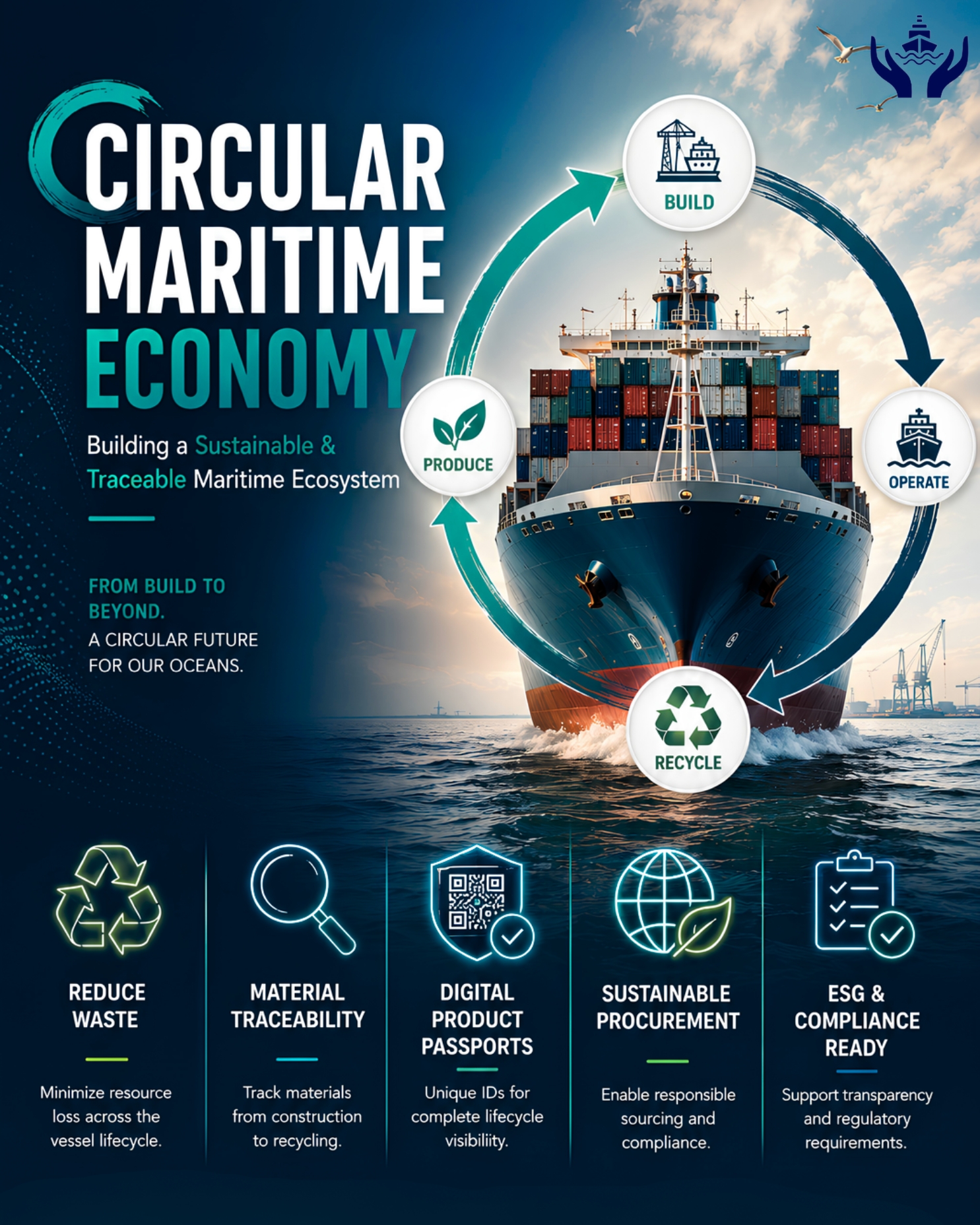
Circular Maritime Economy: Creating a Sustainable and Traceable Maritime Ecosystem

A vision for a maritime industry where every resource is continuously tracked, reused, recycled and managed responsibly — from manufacture to recycling.

Discover how Varuna Sentinels BV helps the maritime sector move from a linear take-make-waste model towards a transparent, traceable and zero-waste ecosystem.

What is the Circular Maritime Economy (CME)?

The Circular Maritime Economy (CME) is a vision for a maritime industry where resources are continuously tracked, reused, recycled and managed responsibly throughout their lifecycle. Unlike the traditional linear economy — where products are manufactured, used and discarded — the circular economy focuses on extending the value of materials and minimising waste.

In the maritime sector, this means understanding every material, component and product used onboard a vessel — from the moment it is manufactured until the vessel is dismantled and recycled.

The objective is simple: reduce waste, improve resource efficiency, enhance transparency and move towards a zero-waste maritime industry.

Tracking Materials Throughout the Entire Vessel Lifecycle

One of the fundamental principles of CME is tracking materials from their origin to their end-of-life stage. Every vessel contains thousands of products sourced from hundreds of suppliers worldwide.

Products Found Onboard a Vessel

  • Steel structures
  • Machinery and engines
  • Electrical equipment
  • Navigation systems
  • Paints and coatings
  • Cables
  • Pumps and valves
  • Furniture and accommodation materials

Without Proper Tracking, It Is Difficult to Know

  • Where materials originated
  • Whether they contain hazardous substances
  • Their environmental impact
  • How they should be recycled at end-of-life

By mapping materials throughout the vessel lifecycle, stakeholders gain complete visibility and can make better sustainability decisions.

Why Material Mapping is Important

Material mapping involves creating a comprehensive record of every significant material and component onboard a vessel. This mapping provides a benchmark that allows organisations to:

Measure Sustainability Performance

Organisations can identify high-impact materials and replace them with more sustainable alternatives.

Improve Resource Efficiency

Understanding material usage helps reduce unnecessary consumption and optimise procurement practices.

Support Circularity

Materials that can be reused or recycled are identified early, reducing waste generation.

Facilitate Responsible Recycling

Accurate material records help ship recycling facilities recover valuable resources safely and efficiently.

Reduce Environmental Impact

Tracking material flows helps organisations identify opportunities to lower carbon emissions and environmental risks.

Moving Towards Zero Waste in Shipping

The maritime industry generates significant amounts of waste during vessel construction, operation, maintenance and recycling. A circular economy seeks to minimise waste by:

  • Reusing components whenever possible
  • Extending product life through maintenance
  • Recycling valuable materials
  • Reducing unnecessary procurement
  • Improving inventory management

Rather than disposing of materials at the end of their useful life, the goal is to return them to productive use. This approach not only benefits the environment but also reduces costs and improves resource availability.

Blockchain-Based Registration System

A major challenge in maritime sustainability is maintaining accurate records throughout a vessel’s lifecycle. Traditional documentation systems often involve multiple parties and fragmented records.

A blockchain-based registration system addresses this challenge by creating a secure and tamper-resistant digital record for every product and stakeholder involved. Each registered product receives a unique digital identity that remains associated with it throughout its lifecycle. This ensures:

  • Data integrity
  • Transparency
  • Traceability
  • Secure information sharing
  • Improved compliance management

Unique Registration ID for Maritime Products

A key element of the Circular Maritime Economy is assigning a unique digital registration ID to every product used onboard a vessel. This digital identity stores essential information such as the manufacturer, supplier details, material composition, compliance certifications, maintenance records and environmental data.

By creating a digital passport for each product, stakeholders can easily trace its origin, monitor its lifecycle and make informed decisions regarding maintenance, replacement, reuse or recycling.

Stakeholders Driving the Circular Maritime Economy

The success of a Circular Maritime Economy depends on collaboration across the entire maritime supply chain:

Ship Builders

Shipyards use traceability systems to verify supplier information, support sustainable procurement practices and maintain accurate vessel documentation during construction.

Ship Recycling Yards

Access to detailed material information enables safer dismantling, better hazardous waste management and more efficient resource recovery at the vessel’s end-of-life stage.

Manufacturers and Suppliers

Manufacturers and suppliers contribute by providing accurate product and material information, improving transparency and supporting sustainability initiatives throughout the supply chain.

Certified Hazmat Companies

Hazardous material specialists use traceability data to support Inventory of Hazardous Materials (IHM) preparation, maintenance and ship recycling compliance.

Flag Administrations & Class Societies

These organisations benefit from reliable material records that support regulatory compliance, vessel inspections and environmental oversight.

Owners, Charterers, Brokers & Insurers

Complete lifecycle visibility helps stakeholders manage ESG obligations, assess sustainability performance, reduce risks and make informed business decisions.

Material Traceability Through MDs and SDoCs

Material traceability is achieved through key documentation such as Material Declarations (MDs) and Supplier Declarations of Conformity (SDoCs):

Material Declarations (MDs)

MDs provide information about a product’s material composition, including any hazardous substances, helping ensure transparency and environmental compliance.

Supplier Declarations of Conformity (SDoCs)

SDoCs confirm that products meet applicable regulations and industry standards, giving confidence in the sourcing and compliance of materials used onboard vessels.

Together, these documents form the foundation of a transparent and traceable maritime supply chain.

Cradle-to-Cradle Traceability

The Circular Maritime Economy promotes complete lifecycle visibility — from manufacturing and procurement to vessel operations and eventual recycling.

This cradle-to-cradle approach enables stakeholders to understand where materials originate, how they are used and how they can be responsibly recovered or recycled at the end of their lifecycle. The result is greater sustainability, reduced waste and improved resource efficiency across the maritime industry.

How Varuna Sentinels B.V. Supports the Circular Maritime Economy

At Varuna Sentinels B.V., we support maritime organisations in building transparent and sustainable supply chains through specialised ESG and compliance services. Our support includes:

Sustainable Procurement Systems

Helping organisations embed sustainability and traceability into everyday sourcing decisions.

IHM Preparation and IHM Maintenance

Accurate Inventory of Hazardous Materials preparation and ongoing maintenance throughout the vessel lifecycle.

Material Documentation Management (MDs & SDoCs)

Structured collection and management of Material Declarations and Supplier Declarations of Conformity.

Supplier Sustainability Assessments

Evaluating suppliers to strengthen transparency and responsible sourcing across the supply chain.

ESG and Scope 3 Emissions Reporting

Robust reporting that captures value-chain emissions and broader ESG performance.

Lifecycle Compliance Management

Managing compliance obligations across the full lifecycle of materials and vessels.

By helping organisations track materials, manage compliance and improve supply chain transparency, we contribute to a more sustainable and circular maritime ecosystem.

Conclusion

The Circular Maritime Economy is transforming the maritime industry by improving transparency, resource efficiency and sustainability throughout a vessel’s lifecycle. Through material traceability, digital documentation and stakeholder collaboration, the industry can move closer to its goal of responsible resource management and zero waste.

Varuna Sentinels B.V. is proud to support this transition by providing practical solutions that enhance compliance, sustainability and lifecycle visibility across the maritime supply chain.

From linear to circular. Build a transparent, traceable and zero-waste maritime ecosystem — one material, one vessel and one decision at a time.

Contact Us

Ready to build a transparent, traceable and circular maritime supply chain? Our experts at Varuna Sentinels BV are here to help you implement material traceability, IHM maintenance and sustainable procurement.

Reach out to us at contact@varuna-sentinels.com or call us at +31 20 24 0355

Visit our website: www.varuna-sentinels.com

Share this article

LinkedIn Twitter Email

Related Articles

Lifecycle Assessment (LCA) for Ships: Carbon Footprint from Construction to Recycling

Read More

EU Ship Recycling Regulation

Read More

Hong Kong Recycling Convention

Read More

Ready to build a circular, traceable maritime supply chain?

Schedule a Meeting Contact Us