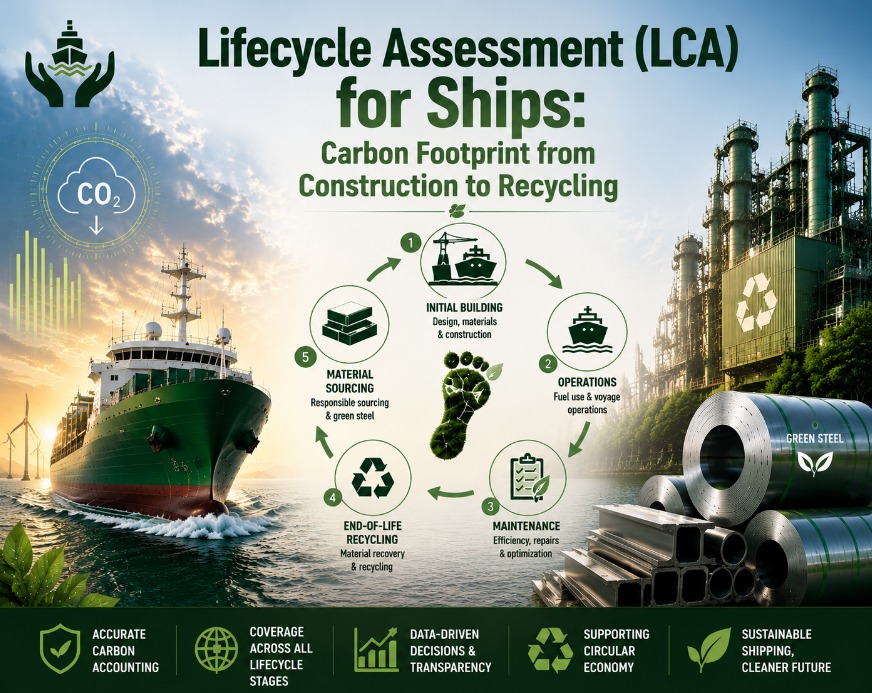
Lifecycle Assessment (LCA) for Ships: Carbon Footprint from Construction to Recycling

The maritime industry is rapidly moving toward decarbonization. Under the IMO’s 2023 GHG Strategy and ongoing Net-Zero Framework (NZF) negotiations, shipping companies are increasingly focusing on Lifecycle Assessment (LCA) to understand and reduce environmental impact across the complete vessel lifecycle.

Unlike operational emissions tracking (tank-to-wake), LCA measures well-to-wake emissions — capturing carbon from fuel production, material extraction, construction, operations, maintenance and end-of-life recycling.

The Lifecycle Challenge for Shipping

At Varuna Sentinels BV, we support the maritime industry with lifecycle-focused solutions — from green steel traceability to operational carbon monitoring and end-of-life material recovery. As regulators move beyond fuel-side emissions to full well-to-wake accountability, every vessel stage matters.

Well-to-Wake, Not Just Tank-to-Wake

  • Fuel production and upstream emissions
  • Material extraction and shipbuilding
  • Vessel operations and maintenance
  • End-of-life recycling and material recovery

Why Shipowners Care Now

  • IMO 2023 GHG Strategy and NZF negotiations
  • Investor and charterer ESG expectations
  • Audit-ready lifecycle CO₂ documentation

The shift: Maritime decarbonization is no longer about a single emissions number — it is about a complete, traceable lifecycle story from steel mill to scrap yard.

Understanding LCA in Shipping

Lifecycle Assessment (LCA) is an ISO-standardized methodology (ISO 14040/14044) used to evaluate the environmental impact of a vessel from construction to recycling.

The IMO is currently developing a global LCA framework through its GESAMP-LCA working group, with technical refinements continuing toward MEPC 85. This framework will establish default emission factors and fuel pathway methodologies for international shipping.

The vessel lifecycle includes:

  • Material sourcing and vessel construction
  • Fuel production and vessel operations
  • Maintenance and lifecycle efficiency
  • End-of-life recycling and material recovery

Standardized, comparable, defensible: ISO-aligned LCA gives shipowners a methodology auditors, regulators and charterers can all rely on.

Construction Phase: Green Steel and Material Sourcing

The environmental impact of a vessel begins during shipbuilding. Steel manufacturing, equipment production and construction activities contribute significantly to carbon emissions.

According to recent LCA research, introducing green steel — manufactured with low or zero GHG emissions — combined with renewable energy at the shipyard could reduce construction-phase GHG emissions by approximately 60%.

At Varuna Sentinels BV, we support lifecycle-focused maritime operations through:

Green Steel Traceability

End-to-end visibility of low-carbon steel from mill to ship — the foundation for accurate lifecycle carbon accounting.

Construction-Phase Carbon Accounting

Structured capture of embodied emissions from materials, equipment and shipyard operations — not just operational CO₂.

Lifecycle Documentation Management

Centralized records aligned with IMO and ISO methodologies — ready for class, charterer and audit review.

Vessel Material Tracking

Track and document key materials onboard, supporting both IHM compliance and circular maritime economy outcomes.

Operational Carbon Monitoring Support

Foundational data flows that connect newbuild records to in-service CO₂ tracking once the vessel is operating.

Full Mill-to-Ship Traceability

Without traceable green steel data, lifecycle carbon claims cannot be verified. We make that chain auditable.

Bottom line: Lifecycle carbon accounting starts at the shipyard, not at the engine. The earlier the data is structured, the stronger the LCA.

Operational Phase: The Largest Contributor

The operational phase produces the highest level of vessel emissions. A major industry LCA study conducted by Lloyd’s Register, Knutsen, HD KSOE and HHI (2023–2026) confirmed:

Where Emissions Come From

  • 79% from ship operations (tank-to-wake)
  • 21% from fuel mining and transport (well-to-tank)
  • Up to ~90% reduction potential with zero- or low-carbon alternative fuels

CII Remains Central

  • IMO’s Carbon Intensity Indicator (CII)
  • Key operational metric for fleet efficiency
  • Drives year-on-year carbon improvement

At Varuna Sentinels BV, we support shipping companies with:

  • Operational carbon monitoring — structured tracking of in-service CO₂
  • Lifecycle data management for well-to-wake emissions — consolidated upstream and operational data
  • Fuel consumption documentation support — audit-ready records
  • Carbon performance tracking — visibility per vessel and per fleet
  • Vessel operational record management — aligned with CII and lifecycle reporting needs

The opportunity: Because the operational phase dominates lifecycle emissions, even modest fuel-side improvements deliver outsized LCA impact.

Maintenance: Impact on Lifecycle Emissions

Regular vessel maintenance is essential for reducing lifecycle emissions. Poorly maintained vessels consume more fuel and generate higher environmental impact.

Lifecycle-focused maintenance supports:

  • Better fuel efficiency — clean hull, tuned machinery, lower SFOC
  • Reduced operational emissions — consistent CII performance
  • Long-term carbon performance — protecting LCA outcomes over the ship’s life

From maintenance to evidence: Proper operational records and performance data strengthen lifecycle carbon accounting across fleets — turning routine maintenance into reportable LCA value.

End-of-Life Recycling: Closing the Carbon Loop

The final stage of a vessel’s lifecycle — recycling — must be included in any complete LCA. Environmentally responsible recycling allows for material recovery and reduces the need for virgin steel production, which carries a high carbon footprint.

Recovered Steel = Lower Lifecycle CO₂

Recycled steel reduces lifecycle emissions compared to new manufacturing — a direct LCA win for vessels reaching end of life.

Circular Economy Alignment

Material recovery supports circular maritime economy principles — turning end-of-life into the start of new value chains.

Lifecycle-Focused Documentation

Capture and structure recycling-phase data so it can be audited and folded into the vessel’s overall LCA story.

Recycling-Phase Operational Support

Aligned with sustainable maritime practices and ship recycling regulation expectations — not just compliance, but evidence.

Closing the loop: At Varuna Sentinels BV, we support shipping companies with lifecycle-focused documentation, material recovery tracking and recycling-phase operational support aligned with sustainable maritime practices.

Digital Lifecycle Data Management

Digitalization plays a major role in modern LCA and carbon footprint tracking. Accurate lifecycle data management helps shipping companies track cradle-to-grave CO₂ visibility.

Our lifecycle-focused support helps organizations:

  • Simplify lifecycle carbon accounting — one structured place for cross-stage CO₂ data
  • Track emissions across all vessel stages — construction, operations, maintenance, recycling
  • Improve LCA reporting accuracy — consistent methodology, defensible numbers
  • Maintain operational lifecycle records — ready for class, regulator and stakeholder review

From scattered data to single lifecycle story: Digital LCA management replaces fragmented spreadsheets with a continuous, auditable record of a vessel’s carbon journey.

Building a Sustainable Maritime Future

The IMO continues working toward a Net-Zero Framework (NZF) with technical and economic measures, including a proposed global fuel standard (GHG Fuel Intensity mechanism) and market-based measures.

Looking ahead:

  • MEPC 85 — Further LCA framework refinements expected
  • Fifth IMO GHG Study — Updated global GHG inventories in progress

From initial vessel building to end-of-life recycling, Varuna Sentinels BV supports shipping companies with lifecycle-focused maritime solutions for greener, compliant and future-ready operations.

Contact Us

Want lifecycle-focused CO₂ visibility across your fleet — from green steel and construction through operations and recycling? Our experts at Varuna Sentinels BV are here to help you build an audit-ready LCA programme.

Reach out to us at contact@varuna-sentinels.com or call us at +31 20 24 0355

Visit our website: www.varuna-sentinels.com

Share this article

LinkedIn Twitter Email

Related Articles

Sustainability in Maritime Services Through Life Cycle Assessment

Read More

Reducing Total CO₂ Through Lifecycle Optimization

Read More

MEPC 84: The Next Era of Environmental Compliance

Read More

Ready to bring lifecycle CO₂ visibility to your fleet?

Schedule a Meeting Contact Us