Five Circular Economy Practices Every Shipping Company Should Adopt in 2026

The maritime industry is moving beyond the traditional take–make–dispose model. A circular approach keeps materials and assets in use for longer, cuts waste, and turns sustainability into a strategic advantage.

Discover the five circular economy practices — with the benefits, implementation steps, challenges and opportunities — that will define resilient, cost-efficient and compliant shipping in 2026.

Why the Circular Economy Matters in 2026

As the maritime industry navigates increasing environmental expectations and stricter regulations, the transition to a circular economy has become essential. Unlike the traditional “take–make–dispose” model, a circular approach focuses on keeping materials and assets in use for as long as possible, minimizing waste and maximizing value.

In 2026, adopting circular practices is not only a sustainability imperative but also a strategic advantage for shipping companies seeking to reduce costs, improve operational efficiency, and strengthen resilience.

The Five Circular Economy Practices

1. Integrate Life Cycle Assessment (LCA) into Decision-Making

Life Cycle Assessment enables shipowners to understand the environmental impacts of a vessel from raw material extraction to end-of-life recycling. By identifying emission hotspots and resource-intensive processes, companies can make informed decisions that reduce their overall footprint and support decarbonization efforts.

Example: A shipowner evaluates the life-cycle impacts of installing wind-assisted propulsion versus a conventional engine upgrade and chooses the option with the lower overall carbon footprint.

2. Embrace Sustainable Procurement

Procurement choices shape a vessel’s long-term sustainability. Prioritizing recyclable materials, environmentally responsible suppliers, and products with lower carbon footprints creates a more resilient and transparent supply chain while advancing corporate goals.

Example: During a vessel retrofit, the procurement team selects recycled steel and environmentally certified marine coatings from suppliers with transparent sustainability practices.

3. Maintain an Accurate Inventory of Hazardous Materials (IHM)

A continuously updated IHM ensures that hazardous substances are properly identified and managed throughout a vessel’s life. This not only supports regulatory compliance but also facilitates safe and environmentally sound ship recycling.

Example: Whenever new equipment or coatings are installed during dry docking, the vessel’s IHM is immediately updated to reflect the changes and ensure compliance.

4. Extend Vessel Service Life Through Upgrades and Maintenance

Preventive maintenance, energy-efficiency retrofits, and timely equipment upgrades can significantly prolong a vessel’s operational life. Extending asset longevity reduces the need for new raw materials and lowers the environmental impacts associated with building replacement ships.

Example: A 15-year-old vessel is fitted with a new propeller, energy-efficient lighting, and a predictive maintenance system, allowing it to operate efficiently for another decade.

5. Partner with Certified Recycling Facilities

Responsible ship recycling is the cornerstone of a circular maritime economy. Working with certified recycling yards ensures the safe recovery of valuable materials, proper waste treatment, and the protection of both workers and the environment.

Example: At the end of its service life, a vessel is sent to a certified recycling yard where over 90% of its steel is recovered and reused, while hazardous wastes are safely managed.
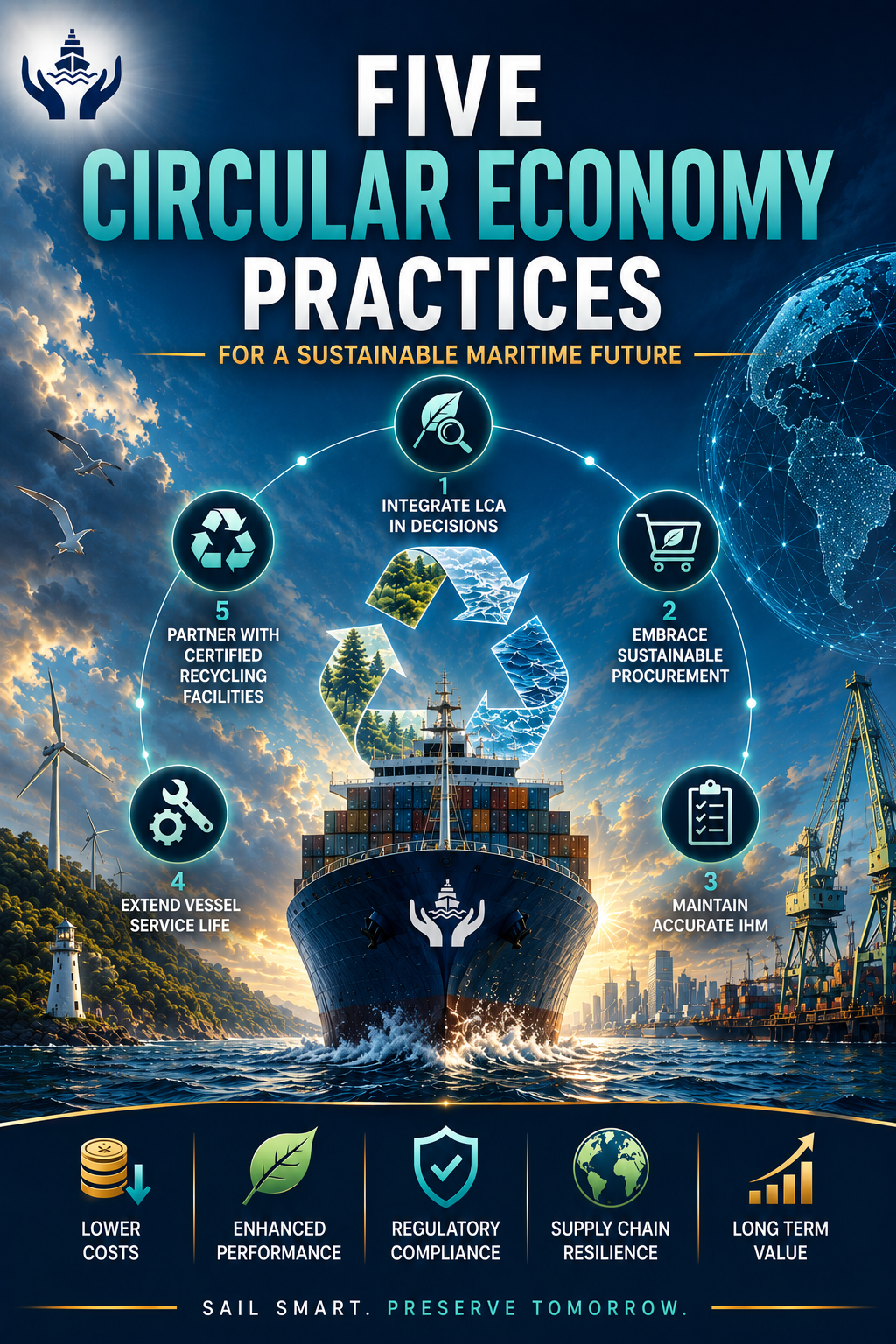
Key Benefits of Adopting Circular Economy Practices

  • Lower Operating Costs — reusing materials and improving efficiency reduce fuel, maintenance, and procurement expenses.
  • Enhanced ESG Performance — circular practices strengthen sustainability metrics and stakeholder confidence.
  • Greater Supply Chain Resilience — sustainable sourcing reduces dependence on scarce or volatile resources.
  • Improved Regulatory Compliance — proactive environmental management helps meet evolving maritime regulations.

Practical Implementation Steps

  • Assess Current Performance: conduct a baseline review of fuel consumption, emissions, waste generation, and resource use across the fleet.
  • Set Clear Targets: establish measurable goals for emissions reduction, waste minimization, and resource efficiency.
  • Integrate LCA: use Life Cycle Assessment to guide decisions on vessel design, retrofits, procurement, and operations.
  • Adopt Sustainable Procurement Policies: prioritize suppliers and materials that align with circular economy objectives.
  • Maintain Accurate IHMs: regularly update the Inventory of Hazardous Materials to ensure compliance and facilitate safe recycling.
  • Train Personnel: educate shipboard and shore-based teams on circular economy principles and best practices to foster a culture of sustainability.

The Business Case for Circular Shipping

Circular practices deliver tangible business value. By extending vessel life, reducing material and energy consumption, and improving operational efficiency, shipping companies can achieve significant cost savings.

Moreover, demonstrating a commitment to sustainability enhances reputation, strengthens relationships with customers and investors, and creates new opportunities in an increasingly environmentally conscious and competitive market.

Challenges & Opportunities

Challenges

  • High Initial Costs: circular technologies often require substantial upfront investment.
  • Complex Supply Chains: coordinating sustainability across suppliers and stakeholders is difficult.
  • Limited Data Availability: accurate life-cycle and material data may not always be accessible.
  • Skills and Training Gaps: employees may need training to adopt new circular practices effectively.
  • Regulatory Uncertainty: evolving environmental regulations can make long-term planning challenging.
  • Resistance to Change: established operational habits may slow the adoption of innovative approaches.

Opportunities

  • Operational Cost Savings: improved efficiency and resource use significantly reduce expenses.
  • Stronger ESG Performance: circular practices enhance sustainability metrics and investor appeal.
  • Digital Innovation: technologies such as IoT and data analytics enable smarter operations.
  • New Revenue Streams: material recovery and recycling can create additional value.
  • Enhanced Brand Reputation: leadership in sustainability strengthens customer trust.
  • Competitive Differentiation: early adopters gain a lasting advantage in a greener market.

How Varuna Sentinels Supports the Circular Transition

At Varuna Sentinels, we help shipping companies embrace circular economy principles through Life Cycle Assessments, continuous IHM maintenance, sustainable procurement solutions, and comprehensive compliance support. Our expertise enables maritime organizations to reduce environmental impacts while enhancing operational and commercial performance.

From strategy to execution: we turn circular economy ambitions into measurable, compliant and commercially sound outcomes across the vessel life cycle.

Conclusion

The circular economy is reshaping the future of shipping. By adopting these five practices, companies can minimize waste, conserve resources, and remain competitive in an increasingly sustainability-driven market.

The journey toward circularity begins today — and those who act now will be best positioned to thrive in the maritime industry of tomorrow.

Contact Us

Ready to embed circular economy practices across your fleet? Our experts at Varuna Sentinels BV can help you integrate LCA, maintain an accurate IHM, source sustainably, and stay compliant — turning circularity into measurable value.

Reach out to us at contact@varuna-sentinels.com or call us at +31 20 24 0355

Visit our website: www.varuna-sentinels.com

Share this article

LinkedIn Twitter Email

Related Articles

Circular Maritime Economy: A Sustainable, Traceable Ecosystem

Read More

EU Ship Recycling Regulation

Read More

Lifecycle Assessment of Ships: Construction to Recycling

Read More

Ready to embed circular economy practices across your fleet?

Schedule a Meeting Contact Us