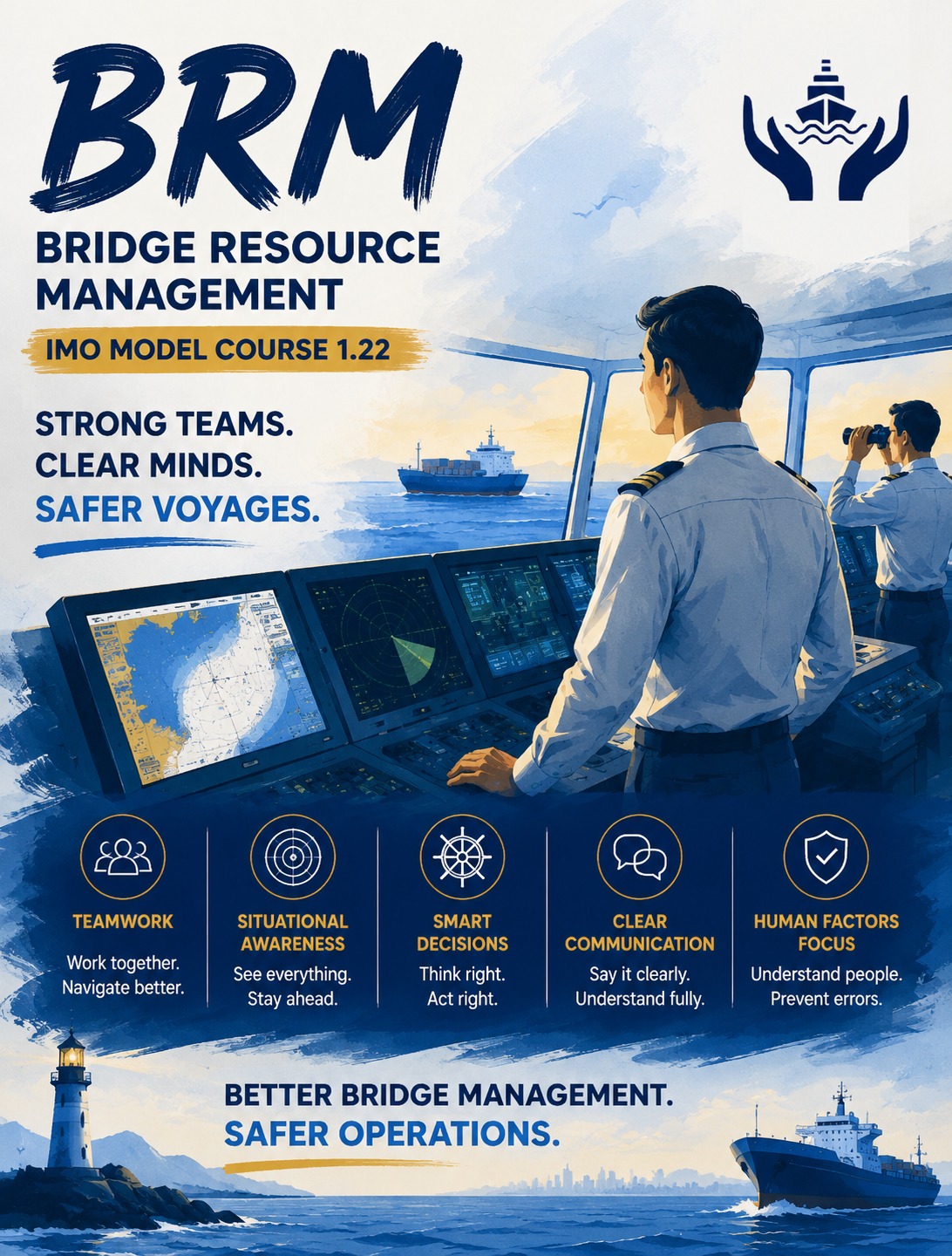
Bridge Resource Management (IMO Model Course 1.22): Building Safer, Smarter, and More Efficient Ship Operations

While modern vessels are equipped with sophisticated navigation technologies, human error remains one of the leading causes of marine accidents. Bridge Resource Management turns skilled individuals into a coordinated, high-performing bridge team.

Discover how BRM, based on IMO Model Course 1.22, equips Masters, Chief Mates and Officers of the Watch to manage bridge operations, optimize teamwork and make informed decisions under normal and emergency conditions.

What is Bridge Resource Management (BRM)?

The maritime industry is evolving rapidly, driven by stricter international regulations, increasing digitalization, and a stronger focus on operational safety. Yet while modern vessels carry sophisticated navigation technologies, human error remains one of the leading causes of marine accidents. Communication gaps, poor situational awareness, and inadequate teamwork continue to be key human-factor risks in navigational operations.

This is where Bridge Resource Management (BRM) plays a vital role. Based on IMO Model Course 1.22, BRM equips Masters, Chief Mates, and Officers of the Watch (Deck) with the skills required to effectively manage bridge operations, optimize teamwork, and make informed decisions under normal and emergency conditions.

In essence, Bridge Resource Management is the systematic management and effective utilization of all available resources — human, technical, and procedural — to ensure the safe navigation of a vessel. Rather than relying solely on the Master, BRM encourages collaborative decision-making, clear communication, continuous monitoring, and proactive risk management among the bridge team.

The primary objective: To minimize human error while maximizing operational safety and efficiency — turning a group of skilled individuals into a single, coordinated bridge team.

Understanding IMO Model Course 1.22

IMO Model Course 1.22 provides the internationally recognized framework for BRM training. It draws on a robust set of conventions, codes, and industry practices that together define safe and competent bridge operations:

  • STCW Convention and Code — establishes the global minimum standards for the training, certification, and watchkeeping of seafarers to ensure safe and competent ship operations.
  • Relevant STCW Competency Requirements — BRM supports the STCW competence requirements applicable to deck officers, particularly in watchkeeping, leadership, teamwork, communication, and safe navigation.
  • International Safety Management (ISM) Code — provides a framework for shipping companies to manage safety, reduce risks, and protect both people and the marine environment.
  • SOLAS Convention — the International Convention for the Safety of Life at Sea sets minimum safety standards for ship construction, equipment, and operation.
  • Best Industry Practices — BRM incorporates globally recognized operational practices adopted by leading shipping companies to improve teamwork, efficiency, and navigational safety across modern fleets.

Who Should Attend BRM Training?

BRM training is designed for every officer who contributes to safe navigation — from the Master to newly promoted deck officers building their confidence on the bridge:

Masters

Responsible for the overall safety and operation of the vessel, Masters benefit from BRM by strengthening leadership and bridge management skills.

Chief Mates

Chief Mates learn to effectively support the Master while managing bridge teams, cargo operations, and emergency situations.

Officers of the Watch (Deck)

These officers gain practical skills in navigation, watchkeeping, communication, and decision-making during routine and critical operations.

Newly Promoted Deck Officers

The course helps newly promoted officers transition into leadership roles by improving confidence, teamwork, and operational awareness.

Navigational Officers on Commercial Vessels

BRM equips navigational officers with the knowledge needed to safely operate vessels in busy and challenging maritime environments.

Professionals Seeking STCW Compliance

Professionals pursuing STCW certification can complete BRM training to meet mandatory international competency requirements.

Effective Bridge Teamwork

A strong bridge team is more than a collection of qualified individuals — it is a coordinated unit where every member understands their role and supports the others. BRM builds this culture through four core practices:

  • Assign responsibilities clearly — clearly defined roles ensure every team member understands their duties, reducing confusion during navigation and emergencies.
  • Monitor each other’s actions — cross-checking each other’s work helps identify errors early and improves the overall safety of bridge operations.
  • Share critical information promptly — timely communication of navigational updates, hazards, and operational changes enables informed decision-making by the bridge team.
  • Support decision-making — team members actively contribute observations and recommendations, helping the Master make safer and more effective decisions.

Situational Awareness

Situational awareness — knowing what is happening around the vessel and anticipating what happens next — is at the heart of safe navigation. BRM sharpens awareness across five critical dimensions:

Vessel Position

Continuously monitoring the vessel’s location ensures safe navigation and compliance with the planned voyage route.

Traffic Density

Understanding nearby vessel movements helps prevent collisions and supports safe manoeuvring in congested waters.

Weather Conditions

Monitoring weather forecasts and sea conditions allows officers to prepare for adverse situations and adjust voyage plans accordingly.

Equipment Status

Regularly checking navigation and communication equipment ensures that critical systems remain operational throughout the voyage.

Navigational Hazards

Identifying shallow waters, reefs, restricted areas, and other hazards helps prevent groundings and accidents.

Decision-Making Under Pressure

Some of the most demanding moments at sea leave little time to think. BRM trains bridge teams to stay calm and make structured, safe decisions when it matters most:

  • Heavy traffic — BRM teaches officers to remain calm and make safe navigational decisions when operating in congested shipping lanes.
  • Restricted visibility — officers learn to use radar, AIS, and other navigation aids effectively when visibility is reduced by fog, rain, or darkness.
  • Equipment failures — training prepares bridge teams to respond quickly and safely when essential navigation or communication equipment malfunctions.
  • Pilotage — BRM improves cooperation between the ship’s bridge team and the marine pilot during port arrivals and departures.
  • Emergency situations — the course develops structured responses for emergencies such as collisions, groundings, fire, or man-overboard incidents.

Communication Excellence

Clear, disciplined communication is what keeps a multilingual bridge team aligned. BRM embeds proven communication techniques into everyday bridge routines:

  • Closed-loop communication — this technique confirms that messages are received, understood, and correctly executed, reducing communication errors.
  • Standard Marine Communication Phrases (SMCP) — SMCP provides internationally recognized phrases that improve communication between multilingual bridge teams.
  • Clear reporting protocols — standardized reporting procedures ensure important operational information is communicated accurately and without delay.
  • Effective Master-Pilot communication — strong communication between the Master and Pilot promotes shared understanding and safer navigation in restricted waters.

Leadership and Team Management

Effective leadership on the bridge is about getting the best from the whole team while maintaining accountability and safety. BRM develops five leadership competencies:

  • Delegation — effective delegation assigns tasks according to each crew member’s skills while ensuring accountability and operational efficiency.
  • Workload management — proper workload distribution prevents fatigue, reduces stress, and maintains safe bridge operations.
  • Assertiveness — BRM encourages officers to confidently raise safety concerns and challenge unsafe decisions when necessary.
  • Conflict resolution — managing disagreements professionally promotes teamwork and prevents conflicts from affecting operational safety.
  • Fatigue awareness — recognizing fatigue symptoms enables officers to take preventive measures that maintain alertness and performance.

Human Factors and Error Prevention

Most navigational incidents trace back to human factors rather than technical failure. BRM raises awareness of the conditions that erode performance — so they can be recognized and managed early:

Fatigue

Long working hours and insufficient rest reduce concentration, increasing the likelihood of operational mistakes.

Stress

High-pressure situations can impair judgment, making effective stress management essential for safe navigation.

Complacency

Overconfidence from routine operations can lead to reduced vigilance and overlooked hazards.

Overconfidence

Excessive confidence may cause officers to ignore procedures or underestimate operational risks.

Distractions

Interruptions and unnecessary activities can divert attention from critical navigational tasks.

Poor Workload Distribution

Uneven task allocation can overload some crew members while leaving others underutilized, increasing the risk of errors.

Why BRM Matters More Than Ever

Modern shipping is more demanding than ever. A combination of busier routes, larger vessels and increasingly digital bridges makes effective resource management indispensable:

  • Higher traffic congestion — increasing global maritime trade has led to busier shipping routes, requiring stronger coordination and navigational awareness.
  • Larger vessels — modern ships are larger and more complex, demanding advanced bridge management and teamwork.
  • Digital navigation systems — digital technologies improve navigation but require officers to understand their capabilities and limitations.
  • ECDIS dependency — heavy reliance on Electronic Chart Display and Information Systems requires officers to maintain manual navigation skills as a backup.
  • Integrated bridge systems — integrated systems combine multiple navigation functions, making effective resource management more important than ever.
  • Environmental compliance requirements — bridge teams must ensure vessel operations align with evolving international environmental regulations.
  • Cybersecurity considerations — as ships become more connected, protecting digital navigation and operational systems from cyber threats is increasingly important.

Benefits for Shipping Companies

Investing in BRM delivers measurable returns — not only in safety, but in cost control, compliance, and crew performance across the fleet:

Improve Navigational Safety

BRM reduces the likelihood of accidents by strengthening bridge teamwork and operational awareness.

Reduce Operational Risks

Better planning and communication help minimize safety, financial, and environmental risks.

Strengthen Bridge Teamwork

Well-coordinated teams improve decision-making and respond more effectively during emergencies.

Minimize Costly Incidents

Preventing accidents reduces repair costs, insurance claims, delays, and reputational damage.

Improve STCW Compliance

BRM helps companies meet international training standards and pass regulatory inspections.

Enhance Crew Confidence

Well-trained officers perform their duties with greater confidence and professionalism.

Foster a Proactive Safety Culture

Encouraging teamwork and hazard reporting creates a stronger culture of safety across the organization.

Support Efficient Voyage Execution

Effective bridge management improves operational efficiency, fuel optimization, and timely voyage completion.

How Varuna Sentinels Supports Safer Maritime Operations

Strong bridge teamwork is one pillar of a safe, compliant and sustainable operation. Varuna Sentinels BV supports shipowners across the wider compliance landscape that surrounds it:

  • Inventory of Hazardous Materials (IHM) Maintenance — Varuna Sentinels helps shipowners maintain accurate and compliant IHM documentation throughout a vessel’s operational life.
  • Maritime ESG Solutions — the company supports environmental, social, and governance (ESG) initiatives that improve sustainability and regulatory compliance.
  • Life Cycle Assessment (LCA) Services — LCA services evaluate the environmental impact of ships throughout their lifecycle, supporting informed sustainability decisions.
  • Maritime Procurement Services (MPS) — Varuna Sentinels streamlines marine procurement by helping shipowners source compliant products and manage supplier documentation efficiently.
  • Regulatory compliance aligned with the Hong Kong Convention — the company assists shipowners in meeting HKC requirements for safe and environmentally sound ship recycling.
  • Continuous documentation management — ongoing updates and verification of compliance documents help shipping companies remain audit-ready and avoid regulatory risks.

Training that scales: Through its Computer Based Training (CBT) platform, Varuna Sentinels BV helps operators deliver consistent, standards-aligned learning — supporting the competency BRM demands across every vessel in the fleet.

Conclusion

Bridge Resource Management is no longer merely a training or compliance requirement; it is a cornerstone of modern maritime safety. As ships become more technologically advanced and operational challenges continue to grow, effective teamwork, communication, and decision-making remain critical to preventing accidents at sea.

Organizations that invest in BRM create bridge teams that are better prepared to manage risks, respond confidently to emergencies, and navigate increasingly complex operational environments. When combined with comprehensive compliance and sustainability services from Varuna Sentinels BV, BRM contributes to a safer, more resilient, and future-ready maritime industry.

Safer, smarter, more efficient operations start on the bridge. Build the teamwork, awareness and decision-making that keep your fleet — and your people — safe.

Contact Us

Want to strengthen bridge teamwork and STCW-aligned competency across your fleet? Our experts at Varuna Sentinels BV are here to help you build safer, smarter maritime operations through training and compliance support.

Reach out to us at contact@varuna-sentinels.com or call us at +31 20 24 0355

Visit our website: www.varuna-sentinels.com

Share this article

LinkedIn Twitter Email

Related Articles

The Future of Maritime Training: AI-Based and Digital CBT Platforms

Read More

New SOLAS Developments for Anchor Handling Winches

Read More

Anchoring Operations: Safe and Efficient Vessel Anchoring

Read More

Ready to build safer, smarter bridge operations across your fleet?

Schedule a Meeting Contact Us