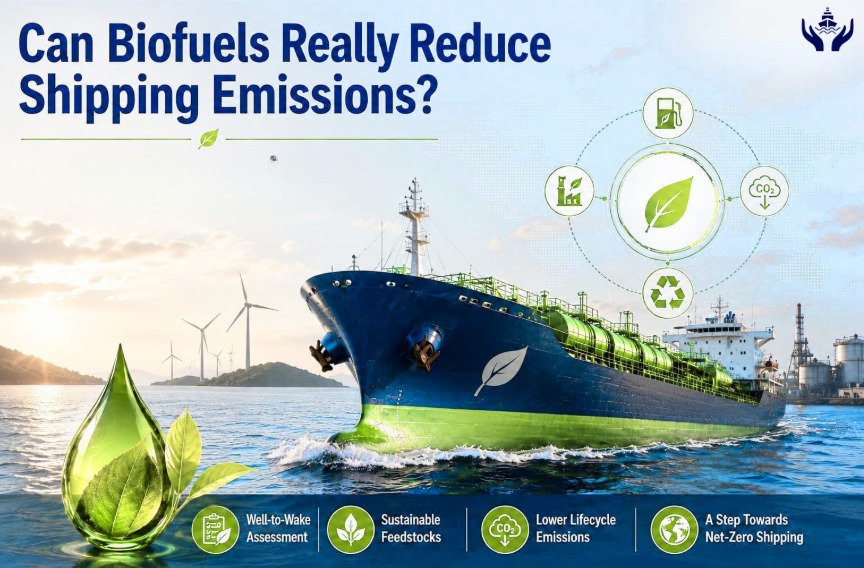
Among the available low-carbon options, biofuels stand out for their compatibility with existing vessels and bunkering infrastructure. However, determining their real environmental value requires a deeper understanding of their entire lifecycle through a Life Cycle Assessment (LCA) — not just what happens at the funnel.
What LCA Measures
Life Cycle Assessment evaluates the environmental impact of a fuel from its origin to its final use. Rather than focusing solely on emissions released during combustion, LCA assesses every stage of the fuel’s journey — and can even capture impacts beyond carbon, such as water use, land use and biodiversity.
Well-to-Wake vs. Tank-to-Wake
Traditional Tank-to-Wake assessments only measure emissions produced onboard a vessel. A Well-to-Wake approach instead includes feedstock sourcing, fuel production, transportation, storage and combustion — providing a far more complete emissions profile.
Why it matters: LCA helps shipowners and operators make informed decisions by revealing the actual carbon footprint of a fuel. It ensures that emission reductions are genuine — and not simply transferred elsewhere in the supply chain.